Book Publications
Review our workbooks, manuals, and practice-based publications, highlighting the latest scholarship in the field of restorative practices. These resources cover everything from the foundations of restorative practices to large-scale implementation in your school or organization, and to how to facilitate challenging situations.
Engage. Connect. Challenge.
Intentional Classroom Engagement is an essential workbook to help you become proactive as you build better relationships with your students, their families, and your colleagues.

Speaking of Race Where We Live, Learn, and Earn by Shelley Jones-Holt is an insightful workbook inviting you to explore your understanding of race through guided reflections and meaningful exercises. Drawing on more than 25 years of experience in education in multiple roles, Dr. Jones-Holt helps you uncover why conversations about race can be so challenging, while equipping you to develop cultural proficiency and confidently lead discussions on this vital topic.

Author Ted Wachtel provides compelling stories and statistics that demonstrate the promise of restorative practices, an exciting social movement. From restorative justice to restorative schools and workplaces, rarely does a proposed solution to challenging problems come with such a compelling track record — persuasive evidence that restorative practices heal victims, prevent bullying, curb conflict and boost satisfaction and productivity.

In this restorative justice mystery, Claire Cassidy is a police detective in Bethlehem, Pennsylvania, who’s beginning to think she’s wasted the last twelve years of her life. She’s tired of watching kids go from juvenile centers to jails, from minor scrapes with the law to full-time careers in crime.
Heart Strong Work: Improving Workplace Culture by Linda Kligman is a practical guide to connecting with colleagues, closing the gaps that divide us, and finding recognition, mutual support, and satisfaction in the workplace.
Exploring the possibility of starting a Peacekeeper Program?
Students want to be leaders and shine when adults empower them. When students are part of the solution, it is a win for the school community. Using the Peacekeeper Conference as a cornerstone, this program helps you give students wings to become compassionate facilitators of reconciliation through healing conversation.
Restorative Circles in Schools: Building Community and Enhancing Learning is a practical guide to the use of circles in schools and other settings, as well as an in-depth exploration of circle processes. The book includes numerous stories about the way circles have been used in many diverse situations, discussion on the use of proactive, responsive and staff circles, and an overview of restorative practices, with particular emphasis on its relationship to circle processes.
What happens when a former political journalist, operative, and consultant in her forties loses faith in her country, moves to a foreign land to seek solace, but still can’t quite give up on the promise of America? And what if—right at that moment—a former schoolteacher and serial entrepreneur is seeking an authentic voice with a healthy amount of skepticism to help him develop a new movement he’s been building up to his entire career?

Two books in one volume, Restorative Justice Conferencing combines (1) the official training manual that provides a step-by-step guide to setting up and conducting conferences and (2) actual conference stories to show how conferencing works and how it can change the way our society responds to wrongdoing in schools, criminal justice, the workplace and elsewhere.

Dive deeper into literacy in your classroom.
Learn how to incorporate individual students’ stories so they experience racially, culturally, linguistically, and economically responsive instruction in multiple forms of literacies.

What happens when learning is approached as a creative transaction between teachers, students, texts, and methods? Based on classroom action research conducted in a diverse suburban school district, the author shares a framework that encourages teachers to approach their work with a restorative mindset by focusing on four elements of instruction: methods; literature; relationships; and culture, identity, and language.
Restorative Practices in Education: Research and Applications brings together the research, experiences, innovations, and insights of teachers, practitioners, and administrators working in classrooms and educational settings across North America.

Start to Circle: 20 Circles for More Magic in Your Classroom offers detailed instructions on running circles with middle and high school students to build connection, openness and security in your classroom and to address issues such as conflicts and recurring problems. Each circle is described in detail including its objective, how to open and close the circle, materials needed, and a time frame for planning. By providing all the specifics of facilitating each kind of circle, the book allows educators to focus on the work of the circle.
Whether you are working with clients that include students, family members, those in the workplace, or the community, The Art of Narrative can be a valuable resource for building better relationships. This is a practical guide for deepening facilitation skills using structured questions that align with restorative practices within circle processes. Useful exercises allow practitioners to enjoy the building blocks found in each chapter to learn post-modern narrative processes so the storyteller is the center of attention rather than the facilitator.
The Restorative Practices Handbook is a practical guide for educators interested in implementing restorative practices, an approach that proactively builds positive school communities while dramatically reducing discipline referrals, suspensions and expulsions. The handbook discusses the spectrum of restorative techniques, offers implementation guidelines, explains how and why the processes work, and relates real-world stories of restorative practices in action.
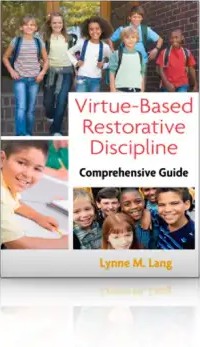
An age-old problem is now a golden opportunity!
From inspiring kids to performing simple acts of kindness, to helping teachers recognize warning signs, to empowering parents, Virtue-Based Restorative Discipline helps put an end to bullying issues and restores a safe, positive, and welcoming environment for all.