Linda Kligman, Ph.D.
Abstract: Businesses that embrace restorative practices have the advantage of creating intentional workplaces where it is safe to innovate. Studies have shown that diverse perspectives, shared learning, and experimentation are factors that spur innovation.
In a restorative work environment, high support is provided to learn and grow, raise concern, and try new things. With high levels of inclusion and energy, restorative practices can help establish group norms, manage expectations, and develop essential interpersonal skills for collaboration. The author draws on Keith Sawyer’s research in group creativity and Sunnie Giles’s studies that scaffold leadership skills to support global innovation, and shares stories that help translate theory into practice. Examples from the International Institute for Restorative Practices depict principles, habits, and team builders that illustrate how restorative practices can spark creativity. The power of connections, conversations, and collaboration explicitly creates an innovative participatory work culture.
Kligman, L. (2021, Spring). Sparking creativity: Workplace applications of restorative practices. IIRP Presidential Paper Series, 3, 1-22.
ABSTRACT
Businesses that embrace restorative practices have the advantage of creating intentional workplaces where it is safe to innovate. Studies have shown that diverse perspectives, shared learning, and experimentation are factors that spur innovation. In a restorative work environment, high support is provided to learn and grow, raise concern, and try new things. With high levels of inclusion and energy, restorative practices can help establish group norms, manage expectations, and develop essential interpersonal skills for collaboration. The author draws on Keith Sawyer’s research in group creativity and Sunnie Giles’s studies that scaffold leadership skills to support global innovation, and shares stories that help translate theory into practice. Examples from the International Institute for Restorative Practices depict principles, habits, and team builders that illustrate how restorative practices can spark creativity. The power of connections, conversations, and collaboration explicitly creates an innovative participatory work culture.
SPARKING CREATIVITY: WORKPLACE APPLICATIONS OF RESTORATIVE PRACTICES
At Google, a multinational company that prizes innovation, managers are not allowed to hire, fire, or promote individuals on their own. Recognizing that diverse perspectives lead to better decisions (Giles, 2018), Google requires these decisions to be made in consultation with others. The Daily Show with Trevor Noah, a successful satirical news broadcast, begins each workday with an idea generation session in which people pitch content by talking over one another, interrupting, and criticizing each other’s ideas (Grant, 2018). Making it safe to criticize others’ ideas allows the staff to quickly sort through possible stories. Instead of practicing traditional brainstorming, where people are encouraged to withhold judgment to generate creative ideas, this “burstiness” is built upon a collegial familiarity. Familiarity is a necessary requirement for group creativity because it paves the way for generating feedback and welcomes participation (Sawyer, 2017; Thompson, 2017). Roche, the international pharmaceutical company, so values relationship-building that they set a key performance indicator to assess employee engagement and participation (F. Hoffmann-La Roche Ltd., 2020). Similarly, Procter & Gamble chooses not to simply focus on research and development budgets; they also quantify social networks to assess their capacity (Sawyer, 2017). These companies choose these measures because they see high engagement and participation as critical for innovation. All the companies and organizations noted here create workplace culture by the structures they build, what they focus on, and the rituals they practice (Brown & Treviño, 2006; Schein & Schein, 2017).
Innovative work environments challenge some of our most basic assumptions about workplace culture, roles, and responsibilities. We see what is possible elsewhere and may wish to achieve similar outcomes in our own workplaces. We also know from research in the fields of leadership and management that certain characteristics have been identified as supporting particular outcomes in work environments. For example, workplaces that encourage diverse perspectives and offer opportunities for shared learning and experimentation are important to nurturing employees’ creativity (Page, 2017; Sawyer, 2017). Some of those characteristics are identifiable in the models offered by Google and others. But trying to replicate models that work in other places and are supported by research does not necessarily lead to success for other companies or organizations trying to improve the creative output of their employees. This may be because some workplaces that have been successful in spurring creativity in the last few decades depended on the personalities of one or two individuals in leadership roles to create and maintain that environment. Or a workplace may have a unique environment that demands creativity as an outcome, such as The Daily Show. But a workplace model does exist that encourages employee creativity and is applicable to a wide variety of workplaces, not personality-dependent, and supported by research.
Restorative practices offers businesses an advantage because it intentionally creates workplaces where innovation is not just welcomed but cultivated. John Bailie (2019) explains that restorative practices creates a sense of belonging, voice, and agency, all characteristics that support individual creativity. Creativity itself has been deemed an inherent part of self-actualization (Richards, 2007). The restorative workplace offers a model that consistently encourages creativity by structuring an intentional workspace that nurtures participatory learning and decision-making and where it is safe to innovate. In addition, the restorative workplace is not specific to any one type of business or profession but can be created with any team of colleagues willing to learn some basic skills. While restorative practices is best known for prescriptive processes that address harm, restorative practitioners are simultaneously creating environments that harness diverse perspectives, provide psychological safety to learn and take risks, and build the skills needed for collaboration. Consequently, choosing to work restoratively provides an excellent foundation for creativity to flourish. Using articulated principles, embedded rituals, and supportive structures, the following examples of a restorative workplace, specifically the International Institute for Restorative Practices Graduate School (IIRP), will show how conversations, connections, and collaboration spark innovation through a participatory work climate. Research in leadership and creativity will also be incorporated to show that what we know about the conditions necessary to structure a workplace that sparks innovation can be provided through the creation of a restorative environment. In addition, while many people are drawn to restorative practices for its relational approach, the skills of communication, connection, and collaboration that it encourages offer a creative advantage. Ultimately, instead of a top-down or personality-driven model, innovation emerges from the processes that build organizational creative capacity.
APPLYING RESEARCH IN GROUP CREATIVITY TO A RESTORATIVE WORKPLACE
In Group Genius: The Creative Power of Collaboration (2017), Keith Sawyer builds on the work of his teacher, psychologist Mihaly Csikszentmihalyi, who was best known for his work on “creative flow.” Csikszentmihalyi had found that, at work, conversation is where most people report experiencing a sense of creative flow (Sawyer, 2017). Sawyer’s work elaborates on the individual process and explores how collaborative webs develop in which “everyone’s creative power increases so that the whole is greater than the sum of the parts” (2017, p. 213). Sawyer defines the resulting dynamic as “group flow,” which provides the ideal conditions for meaningful participation toward a clear goal and an appreciation for one another. For group flow, individuals possess strong listening skills, communication skills, and familiarity with each other that help them build on ideas. In workplaces, developing these skills and making space for collaboration become essential. “Collaboration drives creativity because innovation always emerges from a series of sparks—never a single flash of insight” (Sawyer, 2017, p. 8). Groups can buttress an individual’s skills to support the creative process from conception to actualization. Organizational psychologist Adam Grant (2018) uses the term “burstiness” to highlight the collaborative communication phase of The Daily Show when writers and producers together participate in an excited ideation phase, throwing out as many ideas as they can. Because they have strong relational connections, they are willing to interrupt, criticize, and scaffold thought. The elaboration of an idea can expand an individual’s cognition, making communication essential to creativity.
Beyond enhancing individual cognition, working in groups proffers another critical advantage: diversity. Diversity offers the opportunity to capitalize on others’ knowledge, experiences, and perspectives, all of which have been proven to enhance creativity and innovation (Chin et al., 2016; Giles, 2018; Grant, 2018; Hooker & Csikszentmihalyi, 2003; Hoskisson et al., 2016; Page, 2017; Sawyer, 2017). While Thomas Edison may have been the creative individual famed for inventing the lightbulb, it was a larger creative team effort that over time honed the screw-in style lightbulb, conceived of fuses, and designed large distribution grids that allowed people to overcome the natural limitations of daylight (Sawyer, 2017). As we will see, restorative practices nurtures the qualities of collaboration, communication, connection, and diversity that Sawyer, Grant, and others have shown to be so crucial to sparking creativity in the workplace.
PRINCIPLES AND PROCESSES OF RESTORATIVE PRACTICES FOR INNOVATION
Restorative practices grew out of the field of restorative justice, first crossing into the field of education to address behavioral issues and then into the workplace as a methodology to respond to conflict (Fehr & Gelfand, 2012; Kidder, 2007; Okimoto & Wenzel, 2014). Ted Wachtel defines the fundamental hypothesis of restorative practices: “human beings are happier, more cooperative and productive, and more likely to make positive changes in their behavior when those in positions of authority do things with them, rather than to them or for them” (2013, p. 3). Illustrated by the Social Discipline Window (Figure 2), high expectations with an explicit and clear goal can be paired with strong support to help individuals learn how to self-manage. In a workplace, this dynamic of working with others creates a “restorative milieu—an environment that consistently fosters awareness, empathy and responsibility” (Wachtel, 2013, p. 9). Not just when responding to harm but proactively working together to find creative solutions, colleagues can find motivations for learning and growth through their social relationships.
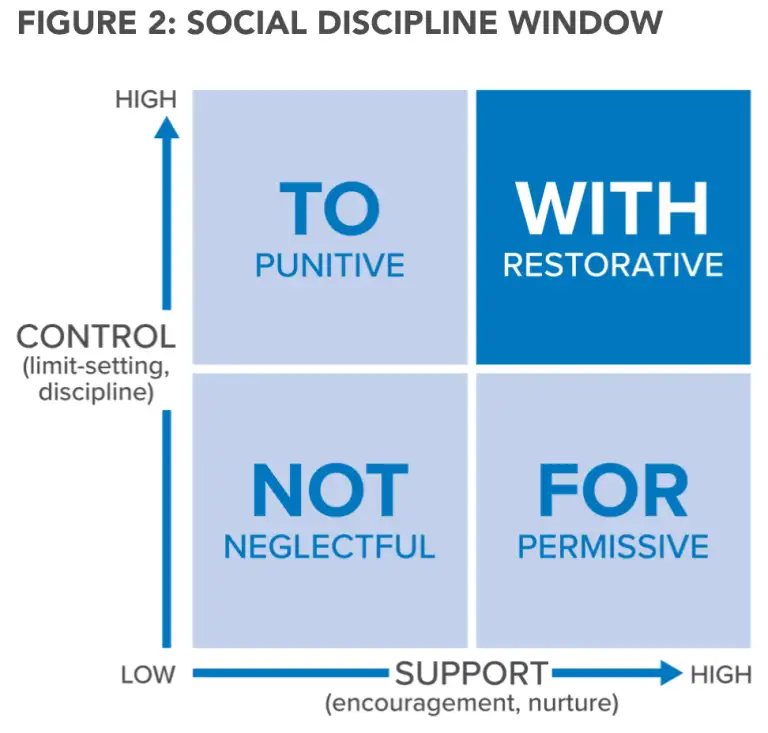
To spur innovation, the next organizational requirement that Giles identified was safety that is achieved by building trust and familiarity. Feedback that monitors and improves systems and relationships is essential to building feelings of safety (Giles, 2018; Goleman, 2006; Hicks, 2011; Kegan & Lahey, 2016; Sawyer, 2017). Detailing her experiences in technology innovation at Google, Apple, Twitter, and other innovative companies, Kim Scott (2017) notes that her success in corporate leadership is based on “radical candor.” Echoing the Social Discipline Window used by restorative practices, she discusses the importance of giving explicit feedback with high personal supports:
[W]hen people trust you and believe you care about them, they are much more likely to 1) accept and act on your praise and criticism; 2) tell you what they really think about what you are doing well and, more importantly, not doing so well; 3) engage in the same behavior with one another, meaning less pushing the rock up the hill again and again; 4) embrace their role on the team; and 5) focus on getting results. (p. 9)
For both individuals and organizations to grow, Kegan & Lahey (2016) tell us that there needs to be “well-held vulnerability” in which one is “feeling as if you are the furthest thing from your most well-put-together self but you are still valued and included” (p. 154). This authentic expression is vital to building relationships and social networks. At the IIRP, valuing growth and positioning feedback to help colleagues grow into their best selves is embedded in our work ethic through “Our Basic Concepts” (2018):
- We believe that people are capable of growing and learning in their work and behavior.
- We respond to situations WITH people, not TO them, FOR them, or NOT at all.
- We separate the deed from the doer by affirming the worth of the individual while disapproving of inappropriate behavior.
- People function best in an environment that encourages free expression of emotion—minimizing the negative, maximizing the positive, but allowing people to say what is really on their minds.
- We are not expected to have all of the answers. Instead of trying to answer or act without adequate knowledge, we need to ask others for help.
- We hold each other accountable by giving and receiving feedback respectfully.
- We act as role models by admitting when we are wrong and being humble.
- We help people develop competencies rather than providing the answers for them.
These are stated expectations for all colleagues regardless of authority or tenure. Developed with input from trustees, faculty, administration, and staff, these concepts are prominently displayed in office spaces. But more importantly, these concepts become evident in staff, departmental, and board meetings, team buildings and other activities; everyone learns how to provide feedback to one another when behaviors do not align with our goals for how we interact with one another.
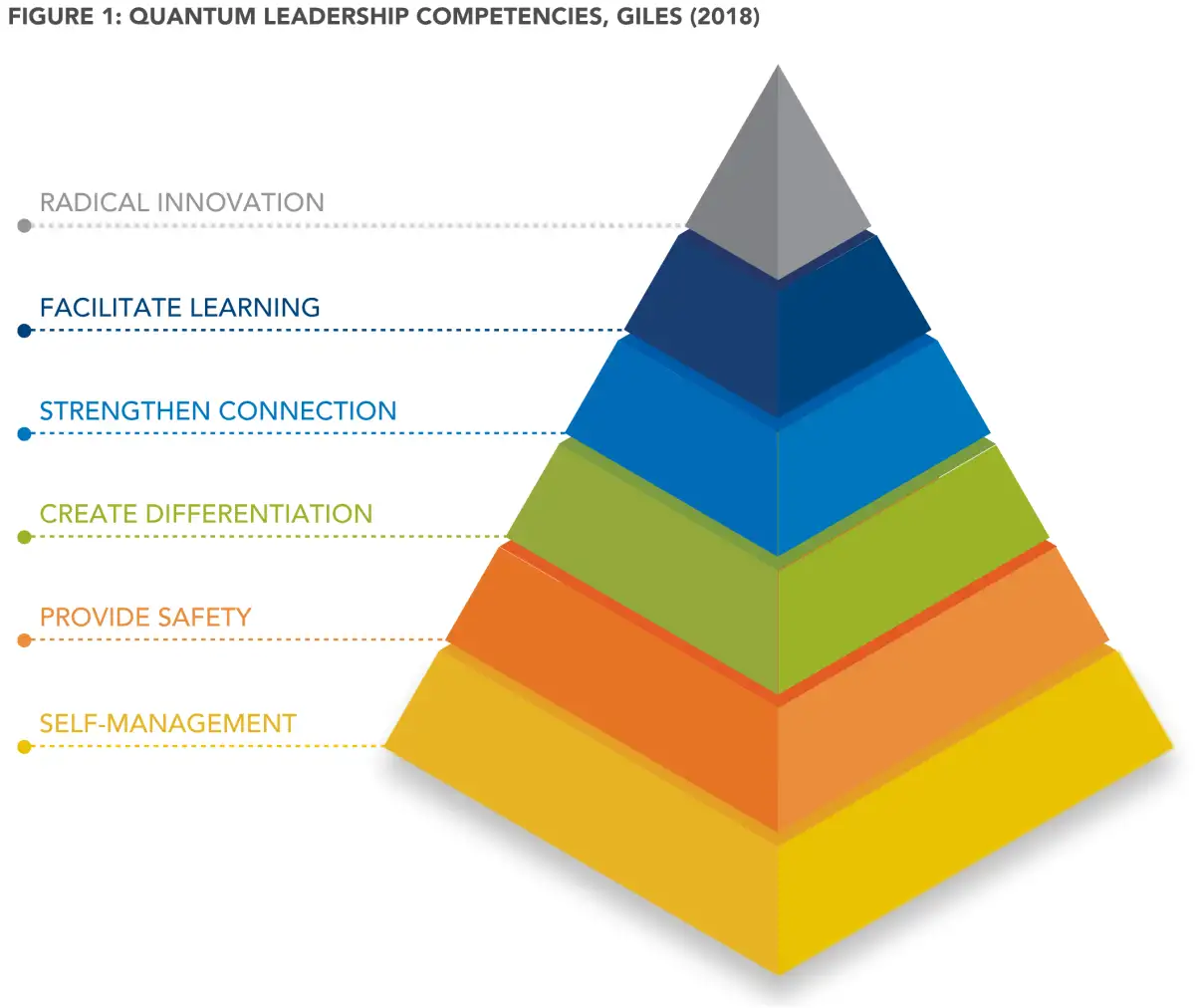
Tension and fear of failure are inevitable when facing problems. Innovation requires consistent and persistent trial and error and a work climate in which it is safe to experiment (Giles, 2018; Hooker & Csikszentmihalyi, 2003; Sawyer, 2017; Scott, 2017). A restorative workplace allows for creative risk and supports trial and error. For example, four of the eight “Basic Concepts” of the IIRP directly express how to handle mistakes by first framing experiences as learning opportunities in work and behavior and upholding a person’s worth even when errors are made. The resulting environment, reinforced by the modelling provided by leadership, encourages employees to admit mistakes and to recognize when they need to ask for help because these are two characteristics the organization values. The research behind Giles’s Quantum Leadership Competencies pyramid (Figure 1) helps us understand why restorative practices is successful at encouraging innovation. Providing a sense of safety in the workplace is supported by the relational underpinnings of feedback and the commitment to working with one another to create reciprocal relationships of support and high aspirations. These specific conditions support the development of a collective psychological safety net that in turn makes employees comfortable to fully express their ideas.
Conflict is inevitable in any workplace, but how conflict is dealt with can greatly affect employees’ creative contributions. How institutions address conflict defines an essential part of their culture (Fehr & Gelfand, 2012; Schein & Schein, 2017). Workplaces that present a façade of harmony might overlook the importance of what Braithwaite (1989) terms necessary “constructive conflict” (p. 185). Restorative practices acknowledges that conflict is inevitable and teaches employees how to recognize and use the opportunity that conflict presents. In many companies an employee might experience a conflict, have a supervisor document a complaint, and have a Human Resource manager file it away in a locked cabinet, where it remains until it is needed to document a persistent failing if no improvement has been shown. A more helpful alternative is to position “leaders as ‘climate engineers’ who reinforce employees’ climate perceptions by developing, enforcing, and implementing a consistent suite of organizational practices” (as cited by Baumann and Bennet in Fehr & Gelfand, 2012, p. 676) to uphold the norms for a collaborative and participatory workplace.
Restorative practices recognizes conflict as such an integral part of human behavior that a continuum of responses has been developed to address conflict depending on the severity and numbers involved. For example, gossip is unacceptable in a restorative workplace; each employee is told this in their orientation. But simply banning gossip would be inadequate to stop it from happening. Instead, employees are taught to address issues colleague-to-colleague with an emotional tenor that allows individuals to recognize how their words or actions may impact others so they can change their behavior. It requires courage and practice but is very effective in stopping gossip, making employees more aware of their words and behaviors, and building empathy.
Further up the continuum, restorative conferencing brings together people who have been impacted, directly or indirectly, to participate in a dialogue process to explore actions and impacts regardless of intention. Rather than minimize or ignore an incident, we speak with candor about how it made us feel, perhaps stressed or worried or unimportant, and build connections—not by taking umbrage but by sharing empathy. The purpose of this conversation is not to punish the employee but rather achieve consensus as to what needs to happen to make things right and support the stated norms of showing respect for colleagues. Restorative conferencing allows colleagues to blend multiple perspectives of truth into a singular understanding and brings conflict resolution out from behind closed doors to allow for institutional learning and growth (Eisenberg, 2016). By including people who are indirectly impacted, such as colleagues who were bystanders to the conflict, the organization has the opportunity to reaffirm basic concepts, define more explicit behavioral expectations, or perhaps encourage leaders to diagnose inadequacies of information distribution. Workplaces that respond to conflict with restorative conferencing improve their employees’ satisfaction and rebalance their sense of trust in the ability of their organization to hold people accountable for their actions (Kidder, 2007; Okimoto & Wenzel, 2014).
As mentioned previously, restorative practices recognizes that employees need support to learn how to voice concerns before conflict escalates. Sawyer’s research (2017) points to courage and familiarity as essential elements to achieving creative group flow and links building trust to solid communication skills. As an accredited graduate school devoted to restorative processes, at the IIRP we aim to “practice what we teach” and train employees in the techniques we teach our students. In addition to embedding feedback in “Our Basic Concepts” (Bailie, 2018), faculty, administration, and staff are taught to use scripted affective statements to ritualize and practice sharing feedback. Feedback is first broached with the statement, “I need to give you feedback,” so that the person receiving the feedback is primed to listen and hear this as a moment for growth. People begin with affective statements, such as “I feel dismissed when you . . .” or “I feel respected when you . . .” which will prompt an empathetic response (Ellison, 2016). Next, the person points to the specific action and makes a request of what might need to happen to repair the situation. For example, “I feel dismissed when you speak to me that way. I feel like I want to withdraw. I ask that when I raise a concern that you don’t understand or think is important, you ask me to elaborate further.” The person receiving feedback is taught to focus on the other person’s feelings and the particular action, not question their perception of reality. The recipient thanks the person for coming to them directly and then repeats the need expressed by the person giving feedback. They respond, “I hear that I shut you down. I will ask you to further elaborate when you think there is a problem so I don’t dismiss your concern.” The feedback, as Scott (2017) would describe, is shared with candor and concern for the relationship. In supervision as well as in staff team-builders at the IIRP, we practice phrasing affective questions and statements such as these. Trusting that people will come directly to you and share their feedback is critical to developing a climate of trust. The IIRP’s dedication to social discipline, supported by communicating with candor and concern, creates an institutional structure for self- management and psychological safety that reflects the solid base of Giles’s Quantum Leadership Competencies pyramid. With that in place, we can begin to facilitate differentiation, which Giles also identifies as important to promoting innovation.
CIRCLES INVITE DIFFERENTIATION
Diversity is crucial to invite various experiences, backgrounds, education levels, and ways of thinking (Chin et al., 2016; Giles, 2018; Grant, 2018; Hooker & Csikszentmihalyi, 2003; Hoskisson et al., 2016; Sawyer, 2017). For innovation to thrive, instilling a clear value to honor and encourage diverse thinking is necessary. This is why, for example, that simply hiring women and minorities falls short despite good intentions to increase diversity. Research has shown that in mixed-gendered working groups, men are more likely to interrupt, exerting dominance in conversation (Karakowsky & Miller, 2004). Research concludes that workplaces still reflect Eurocentric norms that cause bias and, further, that those biases are ignored if colleagues prioritize group harmony over any other factors (Opie & Roberts, 2017). Supporting true inclusion by encouraging the expression and reception of different voices, ideas, and perspectives may include constructive conflict, which can be challenging to any workplace but especially a workplace that has discouraged dealing with conflict. Inclusion will likely need to be structured and practiced before its value can be appreciated for the wealth of new information and opportunities it can bring to a workplace. Rituals of gathering in circles and inviting individuals from every part of the organization into creative processes, practices used regularly in a restorative environment, can be particularly useful in workplace settings. Sharing different perspectives and experiences is an educational opportunity for all employees to understand the experiences of others, to build empathy, and to develop appreciation for strengths that may have been unseen. Essentially, the expression of diversity offers the full experience and capacity of each individual to the group, making the group stronger and more capable.
The circle is the primary meeting format of a restorative workplace, and it is used for a variety of purposes, including standing Monday-morning check-ins; monthly team buildings; regular group and department meetings; and for dealing with specific conflicts. In workplaces, circles model collective leadership and can be “at once highly structured and potentially creative” (Mattaini & Holtschneider, 2017, p. 130). Depending on the needs of the organization, circles can be used to share knowledge, insights, or opinions; express feelings, concerns, or inspirations; or provide and receive feedback. As a model for leadership, Walter Fluker (2009) emphasizes honoring the multitude of realities, being able to “face the other” (p. 37) and make connections in circles. The use of circles for dialogue is familiar to people in many communities; they sit or stand side-by-side without a designated hierarchy. In this formation, everyone present is seen, signifying inclusivity. Oftentimes a talking piece, or symbolic object, is passed from person to person to indicate who will speak without interruption. When a conversation is passed in a sequential circle, people practice and reinforce listening skills and perspective sharing (Costello et al., 2010; Hopkins, 2015; Mattaini & Holtschneider, 2017; Paul & Riforgiate, 2015). In a workplace, this might feel unsettling at first: sitting with colleagues you may not know well, having your whole body from face to foot revealed to others, finding your voice if you are used to being quiet, or practicing reserve if you perceive yourself an expert. Using circles, and speaking in turn, prevents talking over others and provides visual cues that translate values of nondominance and interconnectedness (Pranis, 2012). With practice, circles can be ritualized to build familiarity with each colleague, valuing the whole person and building comfort in authentic expression.
While circles are inclusive structures by nature, their power is not just in the form. They build on our social connections to amplify specific functions. For example, when beginning a meeting, starting with a “check-in circle” can provide a low-risk prompt and invite anyone to respond first and then pick a direction, either to their left or right, to indicate the next person to speak in sequence (Costello et al., 2010; Kegan & Lahey, 2016). This allows people to choose how much personal information they wish to divulge. The sharing of self begins to normalize; seeing a colleague beyond a static professional role creates opportunities for recognizing potential connections, such as a common family structure or a shared hobby or pleasure. When leaders create space for colleagues to express care for others, it builds social capital and social networks (Giles, 2018; Paul & Riforgiate, 2015; Thacker, 2016; Wachtel, 2015). Volunteering to start the check-in could be an initial act of leadership. Restorative practices recognizes that many people have been offered little or no opportunity to develop leadership skills in other workplaces, including small steps like speaking first—or at all—in meetings. Employees can learn to take bigger risks in expression by starting out with smaller risks such as volunteering to speak first and choosing a direction in a low-risk event like a circle check-in.
Check-in circles can also be used to spark creativity. One research study compares different beginning prompts to measure how people’s disclosures impact creative thinking. Prior to a brainstorming session, one group was asked to describe a time they felt proud in the past six months and the other group was prompted to share a time they were embarrassed within the past six months (Thompson, 2017). The group that was asked to relate an embarrassing incident, after overcoming the initial apprehension and expressing vulnerability, enjoyed more laughter and encouragement. The group that shared a proud moment sounded more boastful in their stories.
After completing these prompts, each group was tasked to come up with unusual uses for a cardboard box. The group that shared embarrassing stories came up with 26% more ideas representing 15% more categories. The process of everyone communicating an embarrassing story increased the fluency and flexibility of the group’s creative thinking. The mutual vulnerability that group members experienced during their beginning activity created empathy and familiarity, which helped individuals take a risk to express more creative thought. Additionally, the benefit of working in groups has shown a positive correlation even in subsequent solitary tasks (Sawyer, 2017). This effect lasts for up to five weeks after the group task.
NORMS STRENGTHEN CONNECTION
A misconception around workplace application of restorative practices is that every problem must be solved in a group process. But the workload would move too slowly if that were the case. In fact, a great deal of daily work is performed by employees working individually, during which time they address many problems. So how is respect for group process reconciled with the pressure to get things done? Here again, research supports what we have observed at the IIRP. We know that trusting people to manage themselves is critical for differentiated and distributed work (Giles, 2018; Laloux, 2014). Differentiation allows individuals to work independently and honors their personal style and contribution. People who are self-directed know when to make decisions alone and when to involve others based on the organization’s norms. Rather than policy, organizational norms empower all employees with confidence that their choices will align to organizational expectations (Druskat & Wolff, 2001; Giles, 2018; Heifetz, 1994; Paul & Riforgiate, 2015; Schein & Schein, 2017). Giles’s research of innovative companies (2018) explains Google’s workplace rule: “maximize interaction” allows people to self-organize and move their workspaces around for the purpose of collaboration. Although Google does have boundaries on employees’ independent actions, such as managers cannot promote someone in isolation, the general norm of maximizing interaction allows employees to do things like rearrange workspaces without consulting supervisors. Heuristics such as Google’s allow employees to rapidly process situations and act independently in a manner that will align with organizational values even when they are under pressure. In addition, research has shown that when people have agency to control their environment, they are five times as likely to stick with difficult situations (Giles, 2018). So not only does work get done but employees persist with more difficult tasks that they might otherwise abandon if they were not in an organization that cultivates and values differentiation.
At the IIRP, the norm “people before tasks” empowers individuals to work independently but uphold organizational values. The people part of the equation is the reminder that it is how we interact—by working “with” others—that defines our participatory culture. While everyone is in direct control of how they allocate their time, this rule ensures the IIRP’s values are reflected in how people prioritize their tasks, recognize when a situation may require assistance from others, and address harm when something goes wrong. For example, if a frustrated customer sends an email upset about an experience, an IIRP employee wouldn’t necessarily be required to consult a supervisor before addressing the situation. But, reflecting restorative values, they would refrain from merely typing back an excuse and processing a refund. Rather, applying the norm of “people before tasks,” the employee has to be focused on the relational subcontext of the experience and ensure the customer feels heard. The employee would know they must first empathize with the customer’s disappointment and would prompt a conversation to hear how the interaction impacted the customer and the most difficult consequence of the incident. While it might be more efficient to simply apply a refund, an employee must engage with the person impacted before trying to fix a problem or pursue a task based solely on the employee’s perception. Norms such as those at the IIRP provide applicable rules that allow people to uphold cultural values even in contexts of differentiated roles.
Restorative practices’ support of differentiation does not undermine its stated goal of building community or group. In fact, supporting differentiation and building groups are complementary concepts. For example, differentiation helps group process be even more effective at evaluating ideas rather than generating them (Sawyer, 2017). Differentiation is built upon a base of trust in the individual’s self- management and organizational safety. If colleagues can trust individuals to recognize and manage their emotions, they will have less fear raising different perspectives. But if people do not feel safe or comfortable expressing their individual ideas, do not speak openly, prefer to avoid conflict, and avoid confronting bad ideas, group creativity can be thwarted by “group think” (Breslin, 2018; Richards, 2007).
Differentiation welcomes the creative individual and supports sharing information and learning, as well as making time and space for the creative process (Csikszentmihalyi, 2013). As Sawyer (2017) explains, Edison’s invention of the lightbulb alone did not transform society. The myriad of additive tasks provided by a larger group that built circuits, fuses, and distribution systems made his invention accessible to society and transformed daily life. Bringing together people with differentiated skills after the prototype was developed allowed for more iteration, leading to better design and implementation.
Leaders who want to foster the connections that support diverse views and differentiation prioritize time for team building. At the IIRP, time is devoted to building relationships and leadership skills through monthly team building. Underscoring our inclusive culture, all employees, from president to support staff, allocate time in their calendars to participate as well as rotate leading these events. Every staff member is given a turn to conceive and create a team-builder, facilitate it, and assess the success of the exercise. To build social networks, two people from different departments will conceive an activity for the team-builder and meet to discuss how the staff is working and what kind of activity would help the team grow closer. This process enables employees to reflect on the state of their team and personalize their approach with the benefit of another’s perspective. For instance, if the team is in a forming stage, a lower-risk activity might involve teams of two or three people working together in a scavenger hunt around the building or cooperating to mold objects with Play-Doh. As staff grow in comfort, storytelling might be used to engage in sharing cultural traditions or reflecting on how we can recognize shame or bias in our experiences.
While taking time away from work may seem counterintuitive, social collective tasks build important relational connections but also can improve cognitive processes. Breaks provide critical incubation time away from tasks, allowing creative shifts of thought (Csikszentmihalyi, 2013; Sawyer, 2017). Dermot Breslin (2018) examined what kind of breaks enhance group creativity: individual activities, optional self-organized group engagement, or mandatory collective engagement. Following different experiences during breaks, groups were then asked to participate in creative brainstorming assessing the quantity and quality of creative uses for a cardboard box. The group that participated in mandatory collective activities showed greater fluency and originality in generating creative ideas. Breslin believes group social breaks allow three additional benefits: sharing of ideas with others, interactive flow and idea exchange, and an increased motivation to listen and to share with others. At the IIRP, team building helps us build the interpersonal skills that allow us to appreciate diverse thinking, support differentiation, and build the connections that encourage a collaborative web for innovation.
Following differentiation and ritualizing connection, learning is the final precursor to innovation in the Quantum Leadership Competencies pyramid. By definition, restorative practices prioritizes participatory learning and decision-making. Twice a year, the IIRP conducts a planning and budgeting meeting that utilizes the circle ritual to underscore the commitment to group learning and decision-making. Unlike traditional higher education, where a faculty-senate has elected representatives deliver a documented set of program needs to the administration, all full-time IIRP faculty, administration, and project leaders attend a meeting that makes budgeting transparent to all. Chairs are arranged for a “fishbowl circle” (Wachtel & Wachtel, 2010, p. 35) in which there are two concentric circles of chairs arranged in a room. Within the inner circle, there are chairs for the vice president for administration and chief financial officer as well as open seats for others to join in a conversation. First, full-time faculty take seats within the inner circle and an additional chair is left empty in that circle. Faculty discuss the progress from the year, sharing data as well as stories, upcoming activities, and what resources are required to move forward. The people in the outer circle are listening and learning, but at any point, individuals in the outer circle may walk into the inner circle. Taking the empty extra chair in the inner circle, they can ask a question, provide information, or just share an observation or creative thought. After speaking, that person then moves back to the outer circle, which leaves the seat available for the next person. In this manner, everyone can bear witness and participate in the conversation taking place in the inner circle among the faculty and administration. When the faculty is done sharing their upcoming budgetary needs and everyone else has had a chance to join the conversation, the members of that unit move to the outer circle, and the next unit, such as continuing education or student services, takes the seats within the inner circle. The meeting progresses in the fishbowl format until each unit’s resource needs have been fully discussed. As everyone is educated about each department’s needs, a picture of budget priorities emerges within the group.
Again, recognizing people’s need to belong is not just tokenistic and does not just benefit the individual. Providing opportunities for people outside of the faculty to join conversations around academics diversifies the conversation and brings in additional lifetimes of knowledge and mental resources. For example, a faculty member might be discussing needs to improve the learning management system. Someone from marketing might ask a clarifying question to better understand the pedagogical approach, a technology staff member can make a suggestion based on students’ calls for tech support, and someone from student services could share new innovations they tested at a recent conference. Everyone present has had the opportunity to develop a shared understanding of competing and synergistic needs. Although this process requires more time than issuing a directive for individual employees to shoot an email about funding requests to the vice president, it promotes conversation, group creativity, and the exploration of synergies.
This highly engaging learning process that frames the IIRP’s Budget Day also offers an excellent example of the critical first step of Chan Kim & Renée Mauborgne’s (1997) conceptualization of Fair Process. Fair Process is an explicit technique for participatory decision-making that instructs a person with authority to first engage employees to make a better-informed decision and, following the decision, provide an honest explanation of the rationale for the decision and clear expectations of how the decision will be enacted. Following the IIRP’s daylong meeting using a fishbowl circle to hear from every department, a budget is drafted by the chief financial officer and the vice president. Upon the budget’s approval, everyone is reconvened to explain the new budget, and the vice president provides clear expectations of when and what resources will be available in the coming year. While it will never be possible to meet everyone’s budgeting requests, this transparent process allows people to share what they know and to learn from their colleagues. Group learning reveals the reality of competing needs, but the social connections foster collaboration, and using Fair Process builds support for the resourcing decisions.
RELATIONSHIPS ADVANTAGE INNOVATION
Recent studies in leadership reveal a “power paradox” (Keltner, 2016). Specifically, as leaders develop more power, they tend to lose empathy and become more impulsive and less collaborative. An organization can continue for a long time with little interest in encouraging collaboration. However, crisis can show how important it is to continually build relationships at all levels of an organization so that collaboration is a skill in constant use and ever available. To do this, it is critical to create methods for people on the front lines, closest to the environment, to have influence in creative processes (Cox et al., 2003; Giles, 2018; Laloux, 2014). Leaders need to become facilitators of this collaborative process.
At the IIRP, a commitment to restorative practices primed faculty and staff to share perspectives and ideas and utilize participatory learning and decision-making when the 2009 recession threatened its fledgling graduate school soon after our initial accreditation. Determined to continue the educational mission while transcending geographical and disciplinary boundaries, the faculty reworked curriculum to support blended learning, allowing students from a distance to learn online, thereby ensuring the survival of the IIRP Graduate School and its current students and programs and producing a new revenue stream supplied by a group of new students who could only attend online. Technology staff worked to identify technologies that could support robust video conferencing so students could practice dialogue techniques. Student service staff helped support adult learners mastering online learning management systems. Like Edison’s lightbulb, beyond a vision, the spark of creative thinking required time to make new ideas workable and available. Many people from different departments and with different ideas and skills collaborated to create a rigorous and sustainable graduate school supporting learners around the globe. For a small school without an endowment, we had to rely on a small faculty and staff. As Margaret Wheatley notes, “in this exquisitely connected world it’s never a question of critical mass, it’s always about critical connections” (2006, p. 45).
In 2020, the world underwent seismic shifts when the COVD-19 pandemic closed schools around the globe. In prior years, more than 80% of IIRP’s revenue was earned through in-person professional development, which came to an abrupt halt. At this point faculty and staff divided into creative teams to figure out how to scale our graduate learning modalities that served hundreds into a continuing education platform that could serve thousands. Several months into the pandemic, the compounding impacts of racism sent tremors around the world when George Floyd, an unarmed Black man, was killed by a White police officer. While we were working full-throttle rescheduling events and working in creative teams crunching through instructional design and troubleshooting technology, we recognized our tight focus on tasks did not prevent our hearts from breaking. Remembering our “people before tasks” philosophy, we could not hide behind our busyness and instead we had to shift gears.
Even while working from our different homes, we all had the same response. We began calling each other to ask how people were doing. In these one-to-one conversations, we broached painful and difficult conversations about racism and made it safe to talk about the impacts that disease, isolation, and racism have within our own lives at home and at work. Online, we began holding video conference listening circles for faculty and staff to hear our differentiated experiences, which helped to broaden our understanding and sense of the news and polarizing media.
The fact that we wished to be at the top of the pyramid creating new offerings did not mean that our more important work at our base was forgotten: learning about ourselves and each other, making a workplace that is safe for all voices to be heard, and forging connections that could support very different experiences and perceptions. In fact, our collective restorative training helped us cope with what was happening and encouraged us to find ways to offer help to others. We expanded our listening circles to support our students, offered them to the public, and are developing curriculum to help communities facilitate challenging dialogues on their own. I firmly believe that it is the IIRP’s relational orientation that fuels our spirit: tending to our relationships with each other builds a foundation for creative initiatives.
CONCLUSION
Restorative practices offers a practical and sustainable method for organizations to create a workplace environment that sparks creativity. The basic practices are transferable to many work environments and can be taught, learned, and sustained over time even with changes in personnel and leadership. The workplace characteristics that restorative practices encourages are supported by research, although not explicitly tied to or focused on restorative practices. Using the experience of restorative practices, organizations can mitigate the vulnerabilities of trial and error, learning and growing, and giving and receiving feedback. Articulating expectations and concepts and enacting group rituals while providing norms for individuals to work independently can support a group orientation developing skills for communicating and appreciating uniqueness. Relationships that are reciprocal, rather than dismissive or distanced, build community. For creativity, collaboration can trump competition. This relational perspective requires a major switch in perspective on how leaders, managers, and employees view their workplace dynamic and their relationships with each other. But this new relational perspective can be learned and, as the IIRP can attest, those new relationships become the connective tissue that brings people together and provides durable strength to a creative organization.
I am grateful for the constructive feedback received from my peers through this review process. Their considered questions and suggestions prove the value of connections in the creative process.
REFERENCES
Bailie, J. (2018). Basic concepts shape our culture: A message from our president. Restorative Works, 1.
Bailie, J. (2019). A science of human dignity: Belonging, voice and agency as universal human needs. IIRP Presidential Papers Series, 1, 1–16.
Braithwaite, J. (1989). Crime, shame and reintegration. Cambridge University Press.
Breslin, D. (2018). Off-task social breaks and group creativity. Journal of Creative Behavior, 0(0), 1–12.
Brown, M. E., & Treviño, L. K. (2006). Ethical leadership: A review and future directions. The Leadership Quarterly, 17, 595–616.
Chin, J. L., Desormeaux, L., & Sawyer, K. (2016). Making way for paradigms of diversity leadership. Consulting Psychology Journal: Practice and Research, 68(1), 49–71.
Cox, J. F., Pearce, C., & Perry, M. L. (2003). Toward a model of shared leadership and distributed influence in the innovation process: How shared leadership can enhance new product development team dynamics and effectiveness. In J. A. Conger & C. L. Pearce (Eds.), Shared leadership: Reframing the hows and whys of leadership (pp. 48–76). Sage.
Csikszentmihalyi, M. (2013). Creativity: The psychology of discovery and invention. HarperCollins.
Damasio, A. (2005). Descartes’ error: Emotion, reason, and the human brain. Penguin Books.
Druskat, V. U., & Wolff, S. B. (2001). Building the emotional intelligence of groups. Harvard Business Review, 79(3), 80–90.
Eisenberg, D. T. (2016). The restorative workplace: An organizational learning approach to discrimination. University of Richmond Law Review, 50, 487.
Ellison, S. S. (2016). Taking the war out of our words: The art of powerful non-defensive communication. Voices of Integrity.
F. Hoffmann-La Roche Ltd. (2020). Roche—Our values.
Fehr, R., & Gelfand, M. J. (2012). The forgiving organization: A multilevel model of forgiveness at work. Academy of Management Review, 37(4), 664–688.
Fluker, W. E. (2009). Ethical leadership: The quest for character, civility, and community. Fortress Press.
Giles, S. (2016). The most important leadership competencies, according to leaders around the world. Harvard Business Review Digital Articles, 2–6.
Giles, S. (2018). The new science of radical innovation: The six competencies leaders need to win in a complex world. BenBella Books.
Goleman, D. (2006). Emotional intelligence. Bantam Books.
Grant, A. (Host). (2018, March). The Daily Show’s secret to creativity [Audio podcast]. TED: Ideas Worth Spreading. www.ted.com/talks/worklife_with_adam_grant_creative_burstiness_at_the_daily_show?language=en
Heifetz, R. A. (1994). Leadership without easy answers. Belknap Press of Harvard University Press.
Hicks, D. (2011). Dignity: Its essential role in resolving conflict. The Maple Press.
Hooker, C., & Csikszentmihalyi, M. (2003). Flow, creativity, and shared leadership: Rethinking the motivation and structuring of knowledge work. In C. L. Pearce & J. A. Conger (Eds.), Shared leadership: Reframing the hows and whys of leadership (pp. 217–234). Sage.
Hopkins, B. (2015). From restorative justice to restorative culture. Social Work Review, 14(4), 19–34.
Hoskisson, R. E., Hitt, M. A., Ireland, R. D., & Harrison, J. S. (2016). Strategic leadership. In G. R. Hickman (Ed.), Leading organizations: Perspectives for a new era (3rd ed., pp. 500–532). Sage.
Karakowsky, L., & Miller, D. L. (2004). Gender, perceived competence, and power displays: Examining verbal interruptions in a group context. Small Group Research, 35(4), 407–439.
Kegan, R., & Lahey, L. L. (2016). An everyone culture: Becoming a deliberatively developmental organization. Harvard Business Review Press.
Keltner, D. (2016). Don’t let power corrupt you. Harvard Business Review, 94(10), 112–115.
Kidder, D. L. (2007). Restorative justice: Not “rights,” but the right way to heal relationships at work. International Journal of Conflict Management (Emerald), 18(1), 4–22.
Kim, C., & Mauborgne, R. (1997). Fair process: Managing in the knowledge economy. Harvard Business Review, 75(4), 65–75.
Laloux, F. (2014). Reinventing organizations: A guide to creating organizations inspired by the next stage of human consciousness. Nelson Parker.
Lieberman, M. (2013). Social: Why our brains are wired to connect. Crown.
Mattaini, M., & Holtschneider, C. (2017). Collective leadership and circles: Not invented here. Journal of Organizational Behavior Management, 37(2), 126–141.
Okimoto, T. G., & Wenzel, M. (2014). Bridging diverging perspectives and repairing damaged relationships in the aftermath of workplace transgressions. Business Ethics Quarterly, 24(3), 443–473.
Opie, T., & Roberts, L. M. (2017). Do black lives really matter in the workplace? Restorative justice as a means to reclaim humanity. Equality, Diversity & Inclusion, 36(8), 707–719.
Page, S. E. (2017). The diversity bonus: How great teams pay off in the knowledge economy. Princeton University Press.
Paul, G. D., & Riforgiate, S. (2015). “Putting on a happy face,” “getting back to work,” and “letting go”: Traditional and restorative justice understandings of emotions at work. Electronic Journal of Communication, 25(3 & 4).
Pranis, K. (2012). The restorative impulse. Tikkun, 27(1), 33–34.
Richards, R. (2007). Everyday creativity: Our hidden potential. In R. Richards (Ed.), Everyday creativity and new views of human nature: Psychological, social, and spiritual perspectives (pp. 25–53). American Psychological Association.
Sawyer, K. (2017). Group genius: The creative power of collaboration (2nd ed.). Basic Books.
Schein, E. H., & Schein, P. (2017). Organizational culture and leadership (5th ed.). Wiley.
Scott, K. (2017). Radical candor: How to get what you want by saying what you mean. St. Martin’s Press.
Thacker, K. (2016). The art of authenticity. John Wiley & Sons.
Thompson, L. (2017). Research: For better brainstorming, tell an embarrassing story. Harvard Business Review Digital Articles, 2–4.
Wachtel, J., & Wachtel, T. (2010). Restorative circles in schools: Building community and enhancing learning. International Institute for Restorative Practices.
Wachtel, T. (2013). Defining restorative. International Institute for Restorative Practices. https://www.iirp.edu/restorative-practices/explained
Wachtel, T. (2015). Restorative practices and the life‑world implications of a new social science. Social Work Review / Revista de Asistenta Sociala, 14(4), 7–18.
Wheatley, M. J. (2006). Leadership and the new science: Discovering order in a chaotic world (3rd ed.). Berrett-Koehler Publishers.
Zak, P. J. (2018). The neuroscience of high-trust organizations. Consulting Psychology Journal: Practice and Research, 70(1), 45–58.