Frida C. Rundell, Ph.D., LPC
Abstract: While the process of dealing with trauma is complex, the Relational Care Ladder offers a helpful framework that focuses on supporting the need for safety, awareness, the expression of feelings, and empowerment for children growing up.
The Relational Care Ladder allows practitioners to recognize developmental gaps in children or youth, address immediate behavioral issues, and prevent or ease trauma following them into adulthood. Grounded in the work of developmental theorists, the Relational Care Ladder was developed by the author based on years of experience in educational psychology and restorative practices. When working with young people who’ve experienced trauma, it is critical that adults and other professionals are accountable for creating structure, nurturing, and supporting engagement and appropriate confrontation skills. If adults neglect or fail to provide the rungs of the Relational Care Ladder, children and youth may experience trauma and a deregulation of the central nervous pathways. Support and regulation from professionals and parents are pivotal in trauma proofing our developing youth. This paper offers an explanation of the rungs in the Relational Care Ladder as a quick and easy framework that adults, professionals, and parents may use. Further, restorative processes are shown to be supportive of this work. The Relational Care Ladder provides appropriate guidance when one’s emotions demonstrate implicit trauma memory experiences. Adults, whether parent or professionals, communicate equal accountability for meeting and attending to children’s or client’s respective needs. The range of applicability of the Relational Care Ladder framework will be discussed.
Rundell, F. C. (2021, Summer). Processing trauma using the Relational Care Ladder. IIRP Presidential Paper Series, 4, 1-20.
PDF Download PDF Download (Spanish)
ABSTRACT
While the process of dealing with trauma is complex, the Relational Care Ladder offers a helpful framework that focuses on supporting the need for safety, awareness, the expression of feelings, and empowerment for children growing up. The Relational Care Ladder allows practitioners to recognize developmental gaps in children or youth, address immediate behavioral issues, and prevent or ease trauma following them into adulthood. Grounded in the work of developmental theorists, the Relational Care Ladder was developed by the author based on years of experience in educational psychology and restorative practices. When working with young people who’ve experienced trauma, it is critical that adults and other professionals are accountable for creating structure, nurturing, and supporting engagement and appropriate confrontation skills. If adults neglect or fail to provide the rungs of the Relational Care Ladder, children and youth may experience trauma and a deregulation of the central nervous pathways. Support and regulation from professionals and parents are pivotal in trauma-proofing our developing youth. This paper offers an explanation of the rungs in the Relational Care Ladder as a quick and easy framework that adults, professionals, and parents may use. Further, restorative processes are shown to be supportive of this work. The Relational Care Ladder provides appropriate guidance when one’s emotions demonstrate implicit trauma memory experiences. Adults, whether parent or professionals, communicate equal accountability for meeting and attending to children’s or clients’ respective needs. The range of applicability of the Relational Care Ladder framework will be discussed.
INTRODUCTION
Following years of experience as an educational psychologist studying developmental theory and using restorative practices, I was left with a question: How does restorative practices address the developmental issues of childhood that are neglected? It did not. I began my investigation of this question by exploring the importance that restorative practices places in acknowledging a sense of belonging, voice, and agency or purpose for every individual (Bailie, 2019). The result of my query is the Relational Care Ladder, which can help to identify when behavioral issues may be the result of gaps in a child’s development that have caused harm or trauma and to show how restorative processes can help to address those gaps. The opportunity to address trauma could also help to prevent decades of future problems as childhood harm or trauma can follow a person into adulthood if unaddressed.
Trauma has become a buzzword used to explain away most deficiencies seen in children, youth, and adults today. Trauma was initially identified by the medical profession in soldiers arriving home from World War II and then Vietnam and became known as post-traumatic stress disorder (Levine, 2015). The symptoms of trauma were specific to re-experiencing a traumatic event with recurrent dreams, thoughts, and images with an intensity that creates avoidance and fear. This could result in difficulty sleeping or concentrating, a hypervigilance or exaggerated startle response, nightmares, and recurring negative images. The onset of post-traumatic symptoms can occur up to six months after the event. Currently, trauma and stressor-related disorders include reactive attachment and disinhibited social engagement as well as a range of stress, anxiety, and mood disorders (5th ed.; DSM-5 Guidebook; American Psychiatric Association, 2014; p.169, 496).
Diagnosing post-traumatic stress in children is a significant and relatively recent change. Research Trauma has become a buzzword used to explain away most deficiencies seen in children, youth, and adults today. shows “the clinical expression of psychological distress following exposure to traumatic or stressful events result in fear- or anxiety-based responses and may occur within the womb onwards” (5th ed.; DSM-5 Guidebook; APA; p.189, 170). The right hemisphere of the brain develops in the first two years of a child’s life, creating body and spatial awareness, and social and emotional awareness. This in turn promotes attachment and emotional security during early stages of development where the child encounters the outside world. The result is that this process reinforces a child’s inner understanding of the world and their place in it (Schore & Schore, 2008). But when a child has experienced trauma that disrupts the development of the right hemisphere, this makes attachment and emotional security of the outside world difficult if not impossible.
Emotional security is dependent on physical structure and regulation and child experiences from birth. Structure and nurturing feed the central nervous pathways that flow through the body. It is important to note that when the central nervous system is compromised, the memory is also affected. Levine further explains that the memory of incidents is stored in the motor movement of the cortex, not in the brain. This gives rise to triggers that involuntarily manifest in a bodily experience. Any slight trigger can cause the person to experience an uncomfortable feeling somewhere in the body. Consequently, without thinking, the person reacts to the trigger with an automatic response (e.g., biting lip, stomachache, obsessive movement or thought) (Levine, p. xiii). Bessel van der Kolk (2015) purports that trauma is a very physical experience, one that can become “stuck” in our bodies for years after the trauma-causing incident has taken place.
The uninterrupted development of the central nervous system creates resiliency and the ability to cope with change. Safety and physical and emotional regulation establish and stabilize the organism (van der Kolk, 2015; Levine & Kline, 2008). Experiences that establish structure for a child must be accompanied with nurturing: stress-free affirmations that acknowledge self-worth. An example would be using a warm vocal tone that invites and encourages reciprocal responses in playful ways. A reassuring adult presence accommodates and confirms a safe environment. Adults should try to express feelings through gestures that encourage interaction and reciprocity. In fact, this is what we do when a baby arrives in a mother’s arms. If physical structure and emotional nurturing are not met during childhood or adolescence, they impact a person later in life (Levine & Kline, 2008; Levine, 2015; Siegel, 2013).
Childhood neglect or harm leaves an indelible gap in the development of a young person. However, children learn to be resilient while experiencing the neglect or harm by becoming managers or firefighters for their survival. It is this resilience that they take into adulthood. But managing and firefighting may hinder their potential in adult life due to the intensity or inappropriateness of the control or rescuing behavior that they learned as children.
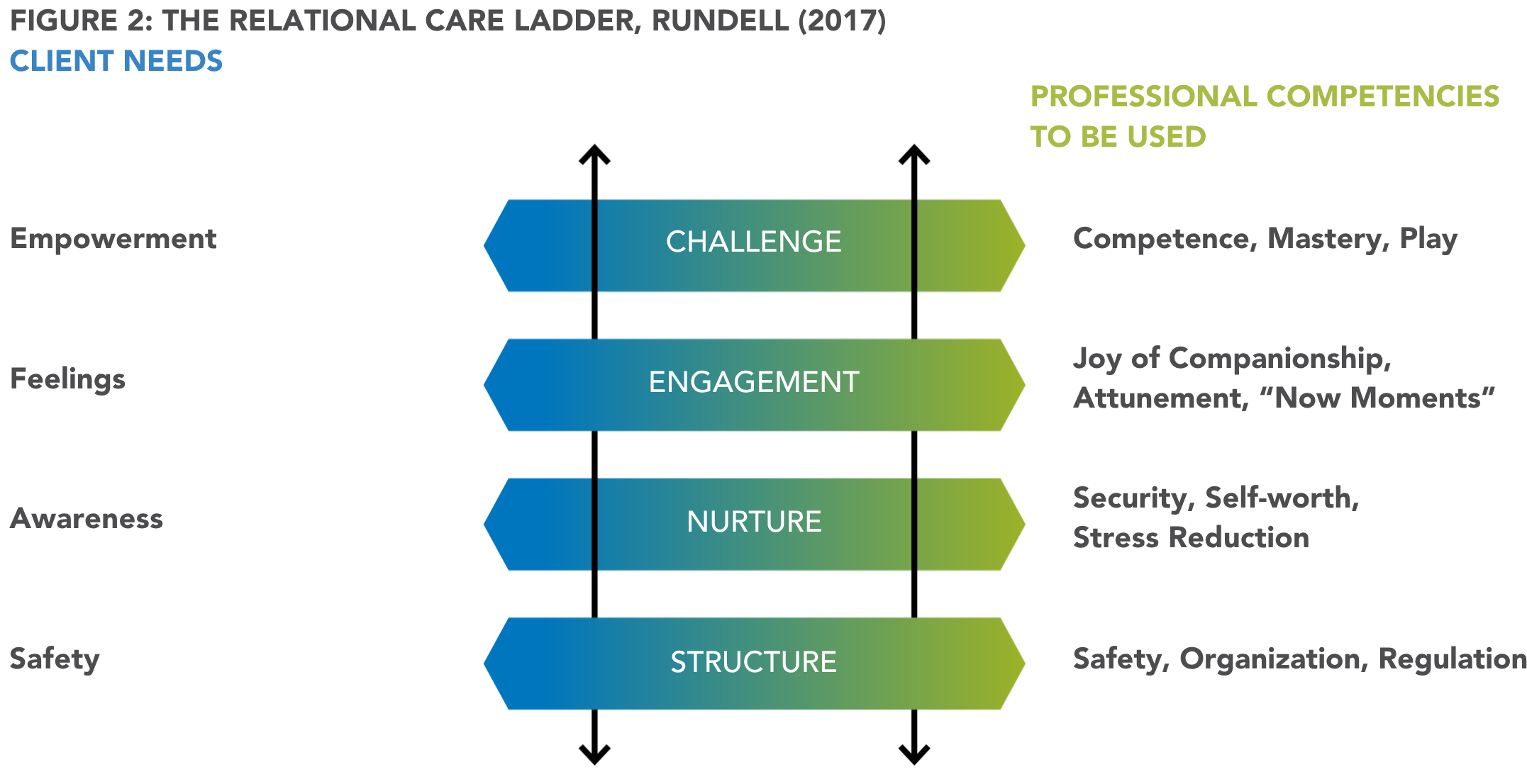
I offer the Relational Care Ladder as a framework to help practitioners to recognize developmental gaps in children or youth, address the immediate behavioral issues, and prevent or ease trauma following them into adulthood. The framework is based on my education and training as a developmental psychologist, my experience working with traumatized children and adults, and my expertise in restorative practices, both as a teacher and a practitioner. Essentially, in trauma, the human organism has crashed and the child or youth needs a caring individual to help realign the central nervous system and the memory to maintain safety. The Relational Care Ladder—with its Structure, Nurturing, Engagement, and Challenge rungs—acts as a guide to help professionals and adults in any caring field become mindful and consistent in creating predictable pathways for healing for the individual who experienced neglect, harm, or adversity.
Honestly sharing feelings allows everyone to stay present and promotes empathy. Setting up responsive circles to challenge behaviors that are not acceptable should only be introduced once proactive circles are a common practice. Fair Process (Kim & Mauborgne, 1997), one of the principles that restorative practices values, with its emphasis on engagement, explanation, and expectation clarity, also complements the Relational Care Ladder. The Relational Care Ladder helps us to be transparent and do things “with” our clients, a goal of restorative processes. It should be noted that the more challenging processes that restorative practices can offer will only be successful after the first three rungs of the ladder are achieved. Overall, the Relational Care Ladder is supported by the proactive aspects of restorative practices.
THE RELATIONAL CARE LADDER
The four rungs of the Relational Care Ladder provide an easy developmental reference to determine what has been lacking in someone’s life. Inappropriate behavior by an individual may reveal an absence or distortion of a need. To provide an appropriate response for healing to take place, the professional or adult should identify which rung on the ladder appears to be an issue for the child or youth, then move one rung below to build on a secure foundation and to begin to address the need of the child or youth. Consistency, predictability, and remaining nonjudgmental are essential at all times. Without these three components, healing will be sporadic and temporary.
To understand how the Relational Care Ladder can help address disruptive behavior that occurred earlier in life, let’s take a closer look at each rung to see why it matters and what is required to successfully navigate it. The rungs are as follows: Structure, which serves to provide safety needs; Nurturing, which promotes awareness in a human being; Engagement, which supports the essential expression of feelings; and finally, Challenge, which invites human endeavors to build a sense of empowerment (Rundell, 2017, Figure 2). It should be noted that you can move up and down the ladder at different times in your life and even within a single day.
STRUCTURE
Structure means that a child learns to identify and address daily tasks and needs in an orderly way. This order provides a sense of safety, organization, and regulation. Providing structure for children requires that adults offer rituals that regulate daily activities in their lives. Attachment to these structures creates trust and safety, an inner knowing and self-acceptance, which in turn provides a responsive flexibility (Schore & Schore, 2008; Porges, 2011; van der Kolk, 2015).
Researchers have found that children who lack structure tend to be overactive, unfocused, overstimulated, and have a desperate need to control a situation (Schore & Schore, 2014; Siegel, 2013). Parents who experienced no structure during their childhoods grow up to be poorly regulated and disorganized and have difficulty setting limits or being a confident leader. They rely on verbal and cognitive structuring or resort to over- or understimulating their children.
To change the negative patterns of a child who has experienced relational trauma, it is necessary to provide a similar direct, interactive, and sensitive emotional experience that challenges old patterns and expectations (Schore & Schore, 2014).
The brain needs the adult to meet the child’s younger emotional needs, to find ways to calm the dysregulated child, and to create feelings of safety for the traumatized child (van der Kolk, 2015). Predictability is important since the child seeks confirmation of even maladaptive internal representations. Communication with the child helps them change their internal representations and provides the necessary developmental support (Makela & Rooney, 2014).
Structure in our surroundings and environment provides confidence. It also helps regulate the neural pathways. Coaching individuals to breathe when feeling unsafe helps deactivate the alarm response. This is critical for any healing to begin. The brain has signaled an amygdala alert. The hippocampus cannot handle the trigger. It then moves into a bodily response, which is known as an implicit memory that may cause the individual to become emotional or choose to subconsciously behave in a ritualistic way (e.g., bite your lips, wash your hands, bite your nails; Levine, 2015). Supportive adults and professionals need to teach the child a process or protocol to respond to and recover from the trigger.
On the Structure rung of the Relational Care Ladder, the primary need is for safety. Providing an environment that is clear of stressors when working with a traumatized child is essential. Safety requires a responsible adult to make decisions to get the traumatized person into a quiet environment without other voices. Safety for all concerned within a family, classroom, or organization requires the environment to be regulated. In restorative practices, we teach the child to move to a safe space, breathe, and splash the face with cold water. This gives permission and time for the trigger to be deactivated. Creating a norm around how to take care of themselves is instrumental to creating structure.
Teaching individuals to use the R.A.I.N. practice increases their awareness of what’s happening to them when in distress.
R is for recognizing that I have a trigger. I am feeling …
A is for accepting and acknowledging the sensation. State it without judging it.
I is for investigating and asking what I need. Where does it sit in my body?
N is for nurturing myself by moving somewhere that gives me a quiet environment. Breathe five deep breaths, stretch, and do something that brings a sense of peace.
(Adapted from Zylowska, L. The R.A.I.N. Practice, Mindful.org)
Any adult can provide a simple and quick response as described above. They could clear the area of people or remove the person to a quiet environment; have the person control their breath by blowing into a paper bag or a balloon; or have them take a quiet walk with a calm adult. It’s advisable not to overwhelm them with questions or a need to respond. Staying with them and having someone be present in a nonthreatening way is critical. This is a drain-off period where only quiet affirmations and validations work. The aim is to achieve normal nervous system regulation (Makela & Rooney, 2014).
There are a number of competencies that adults need to put in place to help ensure that the safety needs of the Structure rung are attained. Levels of regulation and organization bring the predictability of events and happenings into focus. Think of the routines we create at home around regular mealtimes, sleep patterns, celebrations for birthdays and anniversaries, waking up and getting ready, and exercise. A family could have weekly family meetings to discuss issues, distribute chores, and plan fun activities. Greetings at the beginning of the day and farewells at the end of the day must be done regularly; introduce proactive circles that share feelings and fun experiences, as well as acknowledge support gained through the week.
Learn a new word each day and collectively use it throughout the day for fun. These predictable patterns help provide a sense of safety for the child.
Schools meet children’s need for safety when they offer specific schedules for each day and breaks for lunch, recess, and special activities. Within a restorative school, practices like using a circle for check-in and check-out routines within each classroom can provide additional structure and also help teachers build relationships with and among their students (Wachtel, 2013).
Structure is also needed in the adult world. Companies have opening and closing times, return policies, and vacation and sick leave policies. Dismissal protocols and employment benefits are all structures that allow employees to feel secure within their respective organizations. Professional learning groups can provide additional useful structures for business colleagues working on different projects (Sheety & Rundell, 2012).
Within any setting, professionals regulate by introducing predictable ways for clients or employees to meet and share feelings, gain awareness, and challenge themselves through the application of circles, impromptu groups, or one-to-one discussions. Feeling secure and a sense of belonging is dependent on being proactive in any family, school, or business. Remember that consistency and unconditional regard are keys to the success of any structure.
NURTURING
Nurturing may be defined as the task of tending, caring, supporting, and cultivating other people to help them develop. When positive affect is experienced between two people, their self-worth increases. Nurturing children requires that adults provide a sense of security, affirmation of self-worth, and a low-stress environment. Negative and judgmental comments are not nurturing practices and have a detrimental impact on the self-worth of a child. Consequently the child will experience a bodily reaction to negative comments. This physical response becomes a trigger response. The body remembers this long after the incident. Trauma rebounds in the body. When a child experiences a caregiver who is indifferent or neglectful, critical, judgmental, or shaming, that will trigger body memories, which creates emotional pain (Williamson & Anzalone, 1997; Panksepp, 2008; Siegel, 2006).
Children who experience lack of nurturing demonstrate overactive, aggressive, anxious, or pseudomature characteristics; they are often lone rangers and compulsively self-reliant. Parents who lack nurturing themselves tend to be dismissive, harsh, or punitive; have difficulty with touch; and are unable to show emotion (Panksepp, 2008).
To begin responding to the trauma created by a lack of nurturing, professionals and other adults need to provide traumatized children with soothing, hands-on experiences that are repetitive, rhythmic, and rewarding (Panksepp, 2008). Appropriate levels of stimulation to the areas of the brain that are involved in affect regulation are important in retraining the central nervous system. The child/youth requires adults to nurture the child’s self-worth through affective statements and affective questions that demonstrate respect for the child. Showing respect and teaching appropriate verbal and bodily experiences to the child or youth also underscore appropriate touch experiences (Williamson & Anzalone, 1997). Examples of appropriate touch begin with playfully touching different surfaces and naming what the surfaces feel like (e.g., sand, mud, water, sandpaper, being touched with a feather). Affirming and naming feelings or sensations is essential in children’s sensory growth. Verbalizing the touch experiences helps later to know when touch does not feel okay.
Physical and emotional experiences develop realizations and awarenesses essential for recognizing reciprocity between self and others. The key to providing positive affirmations is to do it in calm spaces. Helping a child first to identity and then verbalize their feelings provides them with a structure they can use that allows their neural pathways to make appropriate connections.
You will recognize when behavior is rooted in a lack of nurturing, as a child or a client will respond positively to the affirmations or validations you offer them. The nurturing phase requires an adult to be present, provide security, continue affirming, and whenever the emotions get too overwhelming, guide them back to breathing.
The opportunity for a child or client to gain awareness is important here. It is a significant development if they can learn to recognize a trigger that is causing them a level of discomfort and remove themselves from it, perhaps by leaving the situation and, again, splashing their face with water to ease their discomfort. Awareness can help them begin to identify their triggers more quickly and, with assistance, learn not to respond with a fight-or-flight reflex, withdraw, or attack themselves. In restorative practices, we use the Compass of Shame to reveal how a child, a client, or anyone responds at a subconscious level to a feeling of disempowerment. It has been used even with very young children to help them identify their reactions to shame.
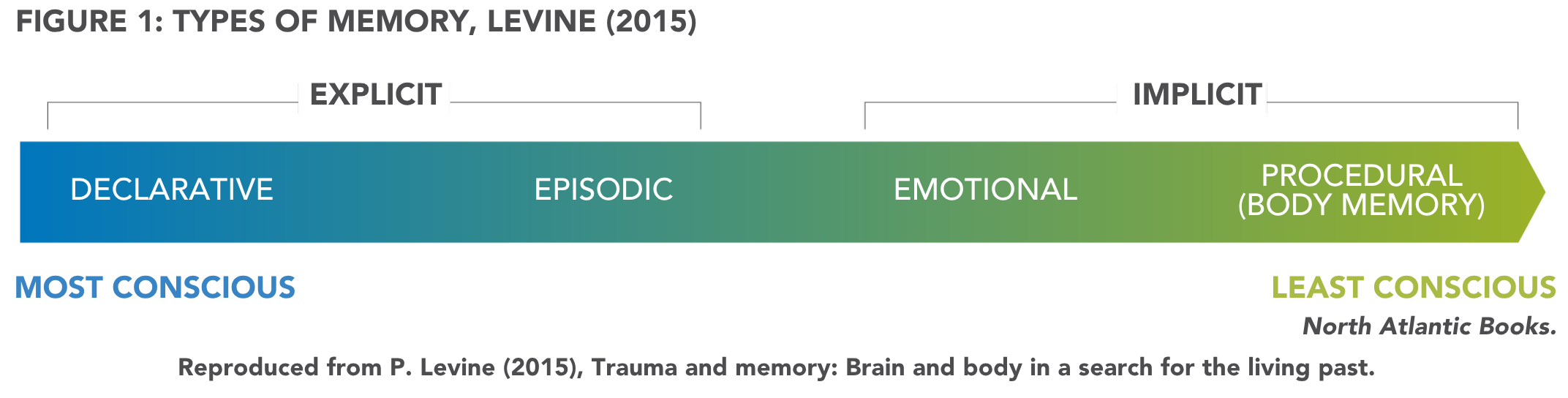
Within the brain, implicit memory is any emotional response or procedural memory patterns that arise when the client least expects it (Levine, 2015, Figure 1). Providing something that soothes—such as walking, squeezing a rubber ball, or having a mantra to say to themselves during this time—is helpful to some. Yoga, exercise, or some sequential movement that allows regulation of breathing to take place helps the procedural memory to feel secure again.

The aim in helping a person build awareness is to identify specifically what happens within the body at the time of the trauma trigger. Allow time for expressing the stormy first draft (SFD), whether they share it orally or in writing to let off steam. This may not be pretty. Do not take it personally. The SFD must be torn up or shredded. Only then can the child or client present in a nonthreatening way to someone in the room. The oxytocin that is produced in the brain of an individual when they are with someone in a nonthreatening way is important. Once the individual becomes aware of where they are and that the sensations in their body have calmed down, they may be ready for the next phase. They are no longer in hyperarousal or hypoarousal (Levine, 1997; Siegel, 1999, Figure 3).

Reciprocity between individuals through affirmations of self-worth goes a long way in families, schools, and businesses to nurture each person’s worthiness. Encouragement rather than criticism brings out a collaborative sense of being. It also reduces stress levels caused by inappropriate expectations. It is important to remember that when correction is needed, we must separate the deed from the doer, another restorative principle. Structuring and nurturing often blend together, especially when both giver and receiver are not in competition with each other. Allowing family dinnertime to be a time to share a feeling that arose during the day and be able to voice how you handled that feeling to your advantage is one way of teaching that all feelings are normal.
ENGAGEMENT
I define engagement as reciprocal verbal or nonverbal interaction between human beings to encourage spontaneous feelings. Adults support a child’s ability to engage by teaching them about the joy of companionship and attunement to others and offering playful moments of attention that celebrate “now moments.” The regulation of emotional affect takes time and patience (Porges, 2011; Winnicott, 1965; Siegel, 2013; Geller & Porges, 2014).
Children who missed the Engagement rung on the Relational Care Ladder display withdrawal, avoid contact, are anxious and rigidly structured, and are uncomfortable with others. The social impact on children later in life is that they become followers; they overidentify with others they get involved with to fulfill the need; they tend to be excessive people pleasers and consequently end up procrastinating due to overcommitments on their part (Porges, 2011; Winnicott, 1965; Siegel, 2013; Geller & Porges, 2014).
The psychological effect of not learning how to engage successfully as children may manifest itself generations later. Parents who never learned how to engage may find themselves preoccupied, inattentive, and out of sync with their child. They rely primarily on verbal engagement and simply do not enjoy the child. They also demonstrate the same characteristics of personal discomfort with crowds.
On this rung of the ladder, conversations about experiences are important. When behavior indicates that one lacks the skills to engage, conversation about an experience may not be forthcoming. A marked withdrawal to socially engage is seen. Once neural pathways have been regulated and the child or client feels safe and nurtured, feelings can be more easily expressed and processed. The aim is to allow the integration of the implicit memory of trauma to merge with the explicit memory (Levine, 2015). Helping the child to experience feelings of safety and self-worth is essential for their healing. Once again, the five restorative questions are helpful tools to begin engagement.
It is essential that questioning the child or client should be reserved for when their thinking or logical brain comes back online and they are no longer emotional. There is no purpose in questioning someone unless structure and nurturing have been established. I have seen parents and practitioners use the restorative questions without doing the preliminary work of structure and nurturing, and it all comes tumbling down like Humpty Dumpty.
The proactive circles common in restorative practices are a great example of nonthreatening experiences that embrace structure and nurturing and encourage feelings to be expressed. Combining the use of a circle with compassionate witnessing is particularly effective in supporting someone who needs a nonthreatening environment to work through an experience (Weingarten, 2003, Figure 5). Compassionate witnessing identifies the central issue through an exploration of the individual’s experience of an incident and allows witnesses to respond with care, curiosity, compassion, and a sense of community (Weingarten, 2003).
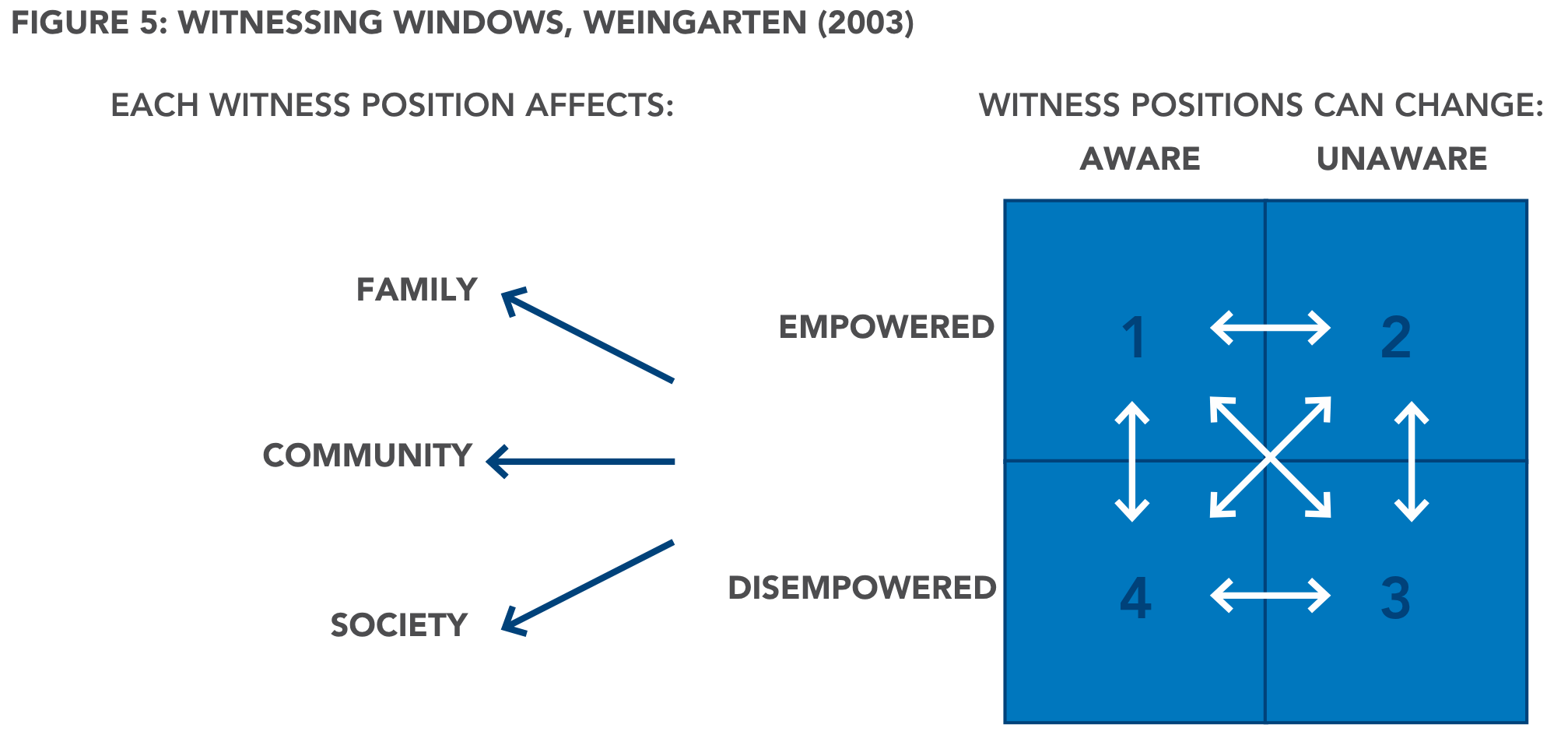
Individuals learn empathy and how to offer support, which allows them to experience the joy of companionship, learn how to be in the “now moment,” and get attuned to others. The Engagement rung’s primary goal is to make space to express feelings (Bluth & Blanton, 2014). Learning to be vulnerable requires safety and awareness that you will not be judged. Only then will you share your personal feelings with others. Once someone is able to share their feelings, they can experience empathy. Being vulnerable is a moving gage. The capability for vulnerabilty depends on with whom the individual feels safe and worthy (Brown, 2015). Brown explores how empathy and shame exist on the same continuum and identifies specific characteristics indicative of each state. The vulnerability a person feels is dependent on how safe they feel in a situation and how much trust they have in others who are involved. These factors can tip them toward either shame or empathy. The creation of empathy is desirable, but being vulnerable to everyone is not advisable. A choice is made within an individual, and safety and trust play major roles in allowing the experience of empathy to occur.
Engagement may also include using right-brain activities. Sharing art, music, sculpting, building Legos, journaling, or any other creative process involving focused activity allows space for chatting about anything with which the individual gets in touch.
Engagement requires the ability to celebrate joy in companionship. To do this we must be prepared to listen and truly stay in the moment with another person (Block, 2008). Too often we see parents who are on their cell phones while ordering their kids around; then they wonder why their kids are not listening to them. Staying attuned to another person and giving them your full attention is an art. Listening empathetically and compassionately takes time and patience. This will be your true test as a supportive adult: to refrain from promoting your opinion and hear the other person. To respond without judgment or advice means you are able to mirror someone else with ease. Engagement requires having a voice and being a good listener too. That is attunement and staying in the “now moment.”
CHALLENGE
On the Challenge rung children learn how to deal with setbacks, changes, and others’ expectations of them. Meeting challenges requires trial and error to feel a sense of accomplishment and competence. Children need experiences with others to learn reciprocity of sharing, restoring, and collaborating. Developing competence, mastery of skills, and playfulness through sports and games teaches reciprocity and the flexibility needed to meet challenges. This in turn allows individuals to feel a sense of empowerment. The impact of learning to navigate challenge is crucial for neural plasticity of the brain (Porges, 2011; Geller & Porges, 2014). Play also allows the child or youth to learn the give and take, positive or negative, of losing and winning. This is a needed competency when meeting any challenge. Successfully navigating the Challenge rung can be inhibited by any negative emotional or verbal experiences with parents or others. An individual may have learned helplessness due to negative feedback.
The ability to be playful should be apparent as a regular part of daily activities for a child. Building these missing skills and competencies requires adults and professionals to engage in sport or games where winning or losing is not guaranteed. Learning to be a good loser and gracious winner are important skills to acquire early in life. Patterns of avoidance, withdrawal, or attacking oneself and others are significant indicators for the professional or adult to note. To counter these behaviors, introduce an activity that is low risk and allows the child’s emotions to be worked through with affective statements of encouragement. Involvement in extramural activities where sharing and collaborating are extensions of the skill they are learning is important. In music, this might include learning to play an instrument and joining a band or learning to sing and be part of a choir. Learning a skill such as karate with an instructor that gives regular constructive feedback is another example. Learning to paint or draw and having the resulting works evaluated would not only help to develop skills and competencies but also to experience challenge, setbacks, and the expectations of others. Role plays and skill building exercises can also be used to teach flexibility in expectations and reciprocity. All of these kinds of activities can support a child to satisfy their need for feelings of self-worth and empowerment and to learn to work through the new emotions that may arise as they move toward building new competencies.
When the Challenge rung is met with appropriate balance during childhood, the adult will continue to enjoy a sense of competence and engagement to support mastering of skills. But a child who has missed this rung of the ladder will be an adult fearful of encountering loss. They tend to be perfectionists who need to please others. As parents they find it extremely difficult to play with their children, are adult in conversation with them, and require adult expectations of perfection, which tend to set up the children with unrealistic adult ideals. The mature characteristic is honored more than the trial and error of daily life. The resulting tendency for child and adult will be to avoid anything unless they can be the very best.
For adults who have missed out on being challenged in childhood because they may have been parentified during that time, recognizing that this is missing in their life is important. Then they may be able to address their relational trauma. Knowing that they have lost the capacity to play begins the journey of recovery (Brendtro & Larson, 2006). Play serves as a less intense form of affection for a child who fends off adult caregiving following trauma (Bloom, 2013). For example, when working in South Africa with child-headed households where both parents had died of AIDS, we had eight-year-olds responsible for four or five siblings younger than themselves. These oldest children had lost the ability to play because they were looking after and feeding and getting their siblings to school. Often their schoolwork suffered and they dropped out, seeking financial opportunities through sex trafficking. Through a Dutch funder, my department at the time established a playground outside a rural school. Every afternoon after school, we had graduate students facilitating activities in seven different parts of the playground. They provided games, storytelling, physical activities, scavenger hunts, painting, sewing, and sand sculpting to support these child-headed households to engage and challenge themselves in a safe space that allowed for their needs for self-awareness, the expression of feelings, and empowerment to be met.
Learning to challenge an individual or yourself to experience a sense of empowerment or agency is vital to human dignity. Not learning how to deal with challenge as children creates one set of problems for adults, but if challenge is the only place recognition is given, many individuals become workaholics or procrastinators because they need to be perfect. Levine & Kline (2008) explain how many adults become expert at managing or firefighting for others, yet never learn to care for themselves. The denial of a balance between self-care and care for others is pivotal. If you are always in your manager or firefighter role, you cloud out your own self-care. A consequence will eventually be professional burnout, which Schwartz (1995) describes as being in exile.
Adults who overachieve on the Challenge rung must learn that micromanaging or playing the rescuer is an attempt at control that keeps them from setting appropriate boundaries and expectations in caring for themselves (Schwartz, 1995).
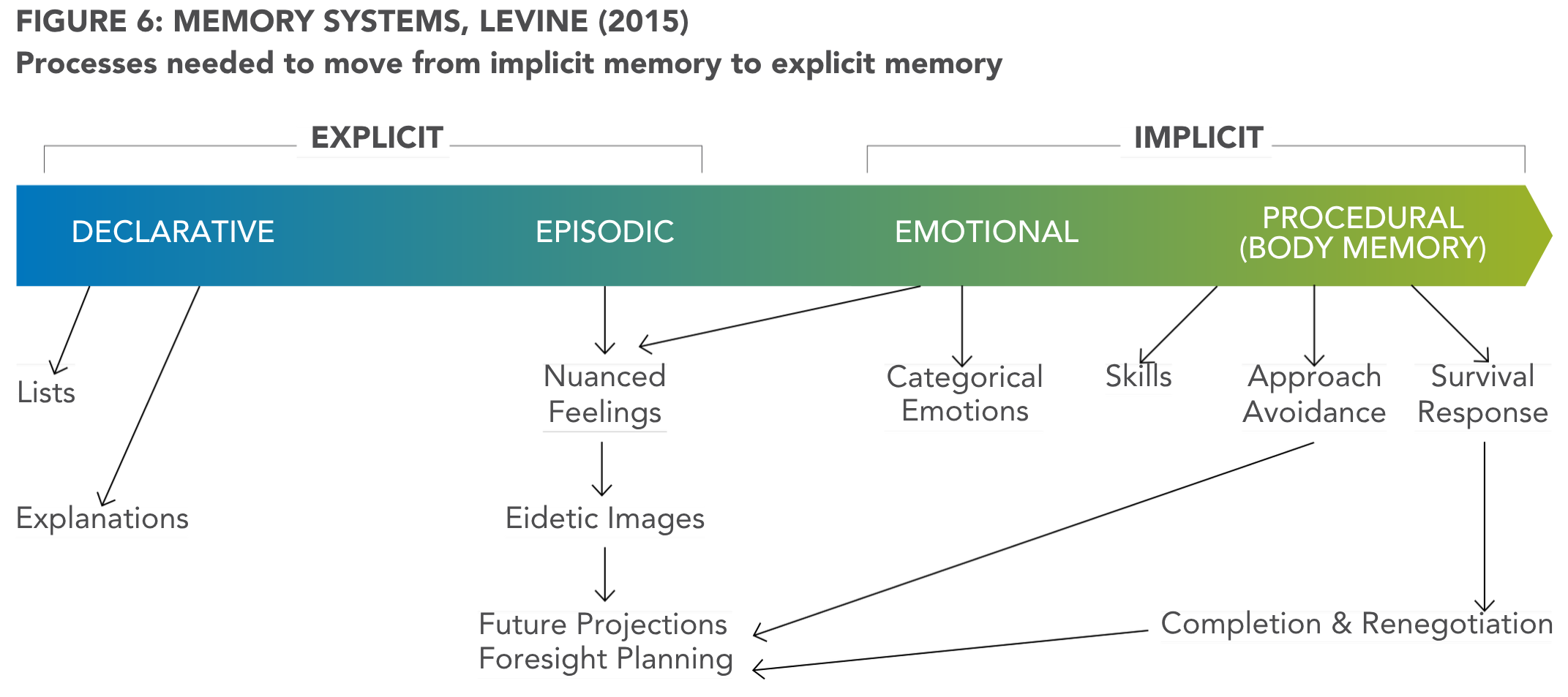
Levine explains how memories that are quickly and readily accessed are known as explicit memories. When trauma or a shocking event occurs, the brain protects the individual by storing the memory in the body. This type of memory then becomes implicit memory and may only be accessed through emotional responses of the body or procedural memories (e.g., obsessive-compulsive behaviors) when triggered. Learning to recognize that an emotion is related to a traumatic memory, and its avoidance or survival responses, allows implicit memories to become explicit and not trigger the same unconscious reaction.
HEALING THE HEALER
If needs were not met at a specific rung level, we enter into adulthood with gaps that may develop into wounds. Being wounded means we continue to wound others subconsciously and stay on the Compass of Shame without awareness. Broken relationships due to trauma create three patterns in adult behavior. They are categorized psychologically by such terms as insecure avoidant attachment, insecure anxious attachment, and disorganized attachment (Porges, 2011; Geller & Porges, 2014). But for our purposes here, they all mean that adults who have experienced trauma as children will have trouble forming and maintaining relationships through their lives. Much of Peter Levine’s work speaks to how the adult body carries with it the traumas of our past. Only through awareness and safety can healing begin. As noted earlier when working with children and youth, the mnemonic R.A.I.N. is equally useful to adults working through past trauma.
We often become caretakers of others due to the experiences of our childhood or lack of experiences. But adults and professionals must work through their own issues before they are ready to help others. Learning to stay with painful experiences, recognize when and where they manifest in the body, and allow for a creative space to ask appropriate questions of ourselves, then assessing what our real need is and nurturing it, gives us, as adults, the power to heal others by honoring children or clients with the same space.
CONCLUSION
Research demonstrates how specific behaviors are present in children and adults when neglect or absence of developmental consistency exists at any one rung of the Relational Care Ladder framework (Brendtro, Brokenleg & Van Bockern, 2009; Levine, 2015; Panksepp, 2003; Panksepp, 2008; Porges, 2011). Examples were given of these behaviors at each phase. Guidelines were offered on how to assist a process of healing at each rung of the ladder, identifying also where and how restorative processes could be used to support this work. It is worth noting that healing is dependent on frequency, intensity, and duration of each trauma response (Rundell, Sheety & Negrea, 2018). Further, the Relational Care Ladder suggests how intentional one needs to be in creating balance between the four rungs of the ladder that feed basic human needs.
Understanding and supporting the developmental stages that children and youth require for establishing resiliency in their central nervous systems give every child a better chance of living more productively and creatively (Brendtro & Larson, 2006). The usual stress every child will experience at home, school, and eventually work will be greater for a child who has missed one of the rungs and their central nervous system will be deregulated as a result.
As adults, we may use the Relational Care Ladder framework as a daily checkup for ourselves and those we care for. A trigger may require us to revisit a rung for a period of time. Healing possible gaps in our development allows the central nervous system to learn new coping strategies (Geller & Porges, 2014). This enables one to move safely up and down the rungs of the ladder with ease. Be mindful that the four rungs of the Relational Care Ladder framework invite continual revisiting and balancing in our daily lives. Balancing our basic needs for safety, awareness, expression of feeling, and empowerment rewards one with the foundation for living richly in the present moment.
The four developmental rungs become the bedrock for resiliency in everyday life. It is worth noting that parents and professionals teach what they know, and we are inclined to reproduce what we are. Using the Relational Care Ladder as a metronome allows professionals and parents to recognize what the self and others need. Besides that, it increases our ability to respond more efficiently and effectively to harmful experiences when encountered. Remaining predictable, consistent, and offering unconditional regard becomes the mantra (Winnicott, 1965).
REFERENCES
American Psychiatric Association. (2013). Diagnostic and statistical manual of mental disorders (5th ed.). https://doi.org/10.1176/appi.books.9780890425596
Bailie, J. W. (2019). A science of human dignity: Belonging, voice and agency as universal human needs. IIRP Presidential Paper Series, 1, 1–16.
Black, D. W., & Grant, J. E. (2014). DSM-5TM guidebook: The essential companion to the diagnostic and statistical manual of mental disorders (Fifth edition). American Psychiatric Publishing, Inc.
Block, P. (2008). Leadership and the small group. TD Magazine, July, 40–43.
Bloom, S. L. (2013). Creating sanctuary: Toward the evolution of sane societies. Routledge.
Bluth, K., & Blanton, P. W. (2014). Mindfulness and Self-Compassion: Exploring Pathways to Adolescent Emotional Well-Being. Journal of Child & Family Studies, 23, 1298–1309.
Brendtro, L. K., Brokenleg, M., & Van Bockern, S. (2009). Reclaiming youth at risk: Our hope for the future. Solution Tree Press.
Brendtro, L. K., & Larson, S. J. (2006). The resilience revolution: Discovering strengths in challenging kids. Solution Tree.
Brown, B. (2015). Rising Strong: How the ability to reset transforms the way we live, love, parent, and lead. Random House.
Geller, S. M., & Porges, S. W. (2014). Therapeutic presence: Neurophysiological mechanisms mediating feeling safe in clinical interactions. Journal of Psychotherapy Integration, 24:178–192.
Kim, W., & Mauborgne, R. (1997). Fair process: Managing in the knowledge economy. Harvard Business Review, 75(4), 65–75.
Levine, P. A. (1997). Waking the tiger: Healing trauma. North Atlantic Books.
Levine, P. A. (2015). Trauma and memory: Brain and body in a search for the living past. North Atlantic Books.
Levine, P. A., & Kline, M. (2008). Trauma-proofing your kids. A parent’s guide for instilling confidence, joy and resilience. North Atlantic Books.
Makela, J., & Rooney, G. (2014). Framing assessment for career services: Telling our story. Journal of New Directions for Student Services, 148, 65–80.
O’Connell, T. (2009). The origins of restorative conferencing. Journal for Peace and Justice Studies, 18, 87–94.
Panksepp, J. (2003). At the interface between the affective, behavioral and cognitive neurosciences: decoding the emotional feelings of the brain. Brain Cognition, 52, 4–14.
Panksepp, J. (2008). The affective brain and core-consciousness: How does neural activity generate emotional feelings? In M. Lewis, J. M. Haviland, & L. F. Barrett (Eds.), Handbook of Emotions (pp. 47–67). Guilford Press.
Porges, S. W. (2011). The Polyvagal theory: Neurophysiological foundations of emotions, attachment, communication, and self-regulation. WW Norton.
Rundell, F. C., Sheety, A., & Negrea, V. (2018). Managing trauma: A restorative process. Refugee Education: Integration and Acceptance of Refugees in Mainstream Education, 11, 17–31.
Schore, J. R., & Schore, A. N. (2008). Modern attachment theory: The central role of affect regulation in development and treatment. Clinical Social Work Journal, 36(1), 9–20.
Schore, J. R., & Schore, A. N. (2014). Regulation theory and affect regulation psychotherapy: A clinical primer. Smith College Studies in Social Work, 84(2-3), 178–195.
Schwartz, R. C. (1995). Internal family systems therapy. Guilford Press.
Sheety, A., & Rundell, F. (2012). A PLG (Professional Learning Group): How to stimulate learners’ engagement in problem-solving. US-China Education Review, 2(5), 497–503.
Siegel, D. J. (1999). The developing mind. Guilford Press.
Siegel, D. J. (2013). Brainstorm: The power and purpose of the teenage brain. Tarcher/Penguin Group.
Van der Kolk, B. (2015). The body keeps the score: Brain, mind, and body in the healing of trauma. Penguin Books.
Weingarten, K. (2003). Common shock. Dutton.
Williamson, G. G., & Anzalone, M. E. (1997). Sensory integration and self-regulation in infants and toddlers: Helping very young children interact with their environment. Zero to Three: National Center for Infants, Toddlers and Families.
Winnicott, D. W. (1965). The family and individual development. Tavistock Publications.