Support the IIRP
  • Login
  • Bookstore (opens in new window)
  • Library
  • Students (opens in new window)
  • Faculty (opens in new window)
International Institute for Restorative Practices (logo)
  • Restorative Practices
    • Restorative Practices: Explained
    • Presidential Paper Series
    • Restorative Works Magazine
    • Restorative Works! Podcast
    • Resources
      • Guides for Implementation
      • Community Health & Restorative Practices
      • Research and Evaluations
      • Integrating Related Evidence-Based Strategies
      • Case Studies
      • Publications
    • News & Announcements
  • Graduate Education
    • Graduate Programs
      • Master of Science
      • Education Specialization
      • Community Engagement Specialization
      • Master of Science with Thesis Option
      • Graduate Certificate in Restorative Practices
      • Graduate Certificate in Relational Facilitation for Healing Trauma
      • Graduate Certificate in Change Implementation in Organizations and Social Systems
    • Course Offerings
    • Registration & Admission
      • Program Application
      • Course Registration
      • Graduate Course Schedule
      • Transcript Requests
      • Frequently Asked Questions
      • Academic Catalog & Student Handbook
        • Introduction
        • Institutional Statements
        • Academic Calendar
        • Academic Catalog
          • Courses
          • Admissions
          • Educational Programs
          • Institutional Learning & Program Goals
        • Student Handbook
          • Health & Safety
          • Technology
          • Tuition & Fees
          • Student Support
          • Financial Aid & Scholarships
          • Campus Location
          • Academic Policies & Procedures
          • Accreditation
          • Institutional Policies
        • Index
    • Transparent Tuition
      • Tuition & Fees
      • Payment Plan
      • Cost of Attendance
    • Scholarships
    • Recruit Our Students
    • Philosophy & Academic Goals
  • Continuing Education
    • View All Offerings
    • Professional Development
      • Restorative Practices for Educators
      • Navigating Conflict: Restorative Practices in the Workplace
      • Restorative Practices at Work: Relational Tools for Culture Change
      • Connection and Content: Integrating Restorative Practices into Classroom Learning
      • Implementing with Intention: Effecting Change Through a Relational Lens
      • Facilitating Listening Circles
      • Restorative Justice Conferencing
      • Putting Theory into Practice for School Staff and Administrators
      • Reimagining Campus Community with Restorative Practices
    • Bring Our Events to Your Team
    • Restorative Practices Training of Trainers
    • Conferences & Symposia
    • Free Webinars
  • Collaborative Application
    • Consultative & Implementation Services
    • Whole-School Change
      • Program Overview
      • School Resources
      • Frequently Asked Questions
    • The Commons
      • Get Involved
  • About
    • The IIRP Graduate School
    • Message from the President
    • Who We Are
      • Faculty
      • Instructors
      • Leadership
      • Trustees
      • Alumni
      • Factbook
    • Support the IIRP
    • Employment at the IIRP
    • Accreditation Information
    • Research Agenda
    • Lenape Nation Acknowledgment
    • Consumer Information (Higher Education Opportunity Act)
  • Contact Us

News & Announcements

Subscribe to IIRP News, the IIRP’s monthly newsletter.

Subscribe to IIRP News

Sign up for our monthly e-newsletter, IIRP News, to receive information on the latest trends in the restorative practices field, encouraging stories from our students and alum, and the latest IIRP offerings. 

Please let us know your name.

Please write a subject for your message.

Please let us know your email address.

Invalid Input

Invalid Input

Invalid Input

Healing in Our Land: Jamaica Hosts International Conference on Restorative Justice

Published: July 12, 2007

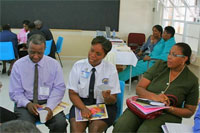
Participants at the Restorative Justice Training, at Northern Caribbean University, in Mandeville, Jamaica

Jamaica is a beautiful country, but it is deeply troubled by poverty and violence. “Anyone who has followed Jamaica over the past 10 to 20 years can see our country has suffered from the loss of communal relationships that once existed. The issue of crime and violence is dominant at present,” noted Dr. Teran Milford, dean of the College of Teacher Education and Behavioural Sciences at Northern Caribbean University (NCU), in Mandeville. “One way to rebuild structures and rebuild relationships is through restorative justice,” he added. “Rather than just punishing a perpetrator of crime, we want to find ways to reinstate the perpetrator back in the community.”

Read more

Restorative Practices in Schools: Research Reveals Power of Restorative Approach, Part II

Published: June 6, 2007

As an increasing number of schools worldwide adopt restorative practices as a means of dealing with discipline and improving school culture, school leaders are beginning to analyze the impact of restorative methods. The numbers tell a powerful story: Schools implementing restorative methods have seen a drop in disciplinary problems, decreased reliance on detention and suspension, and an improvement in student attitudes. Gathering such data is important, both for evaluating the effectiveness of restorative methods and garnering funding support for restorative programs.

Read more

Restorative Justice: The Evidence — Report Draws Attention to RJ in the UK

Published: May 16, 2007


Dr. Lawrence W. Sherman and Dr. Heather Strang, both longtime researchers on the effectiveness of restorative justice (RJ), have recently published a major new study titled “Restorative Justice: The Evidence.” Published in the UK, carried out by the Jerry Lee Center of Criminology at the University of Pennsylvania, Philadelphia, and sponsored by the Smith Institute, an independent think tank based in London, the study concludes that RJ—no matter how it is measured—is as or more effective than traditional methods of criminal justice (CJ) for reducing crime with respect to nearly every group of offender studied.

“There is far more evidence on RJ, with more positive results, than there has been for most innovations in criminal justice.”

—From “Restorative Justice: The Evidence”

Read more

An Eloquent Expression of Restorative Justice

Published: March 21, 2007

BBC Radio has posted a "Lent Talk" by prominent UK barrister Cherie Booth,QC (Queen''s Counsel), about the themes of restorative justice in thestory of Zacchaeus. (Booth is married to UK Prime Minister Tony Blair.)She also tells several contemporary restorative justice stories. Hertalk is an eloquent expression of the essence of restorative justice.Available on the web as text or audio.
 

Read more

Restorative Practices in Schools: Research Reveals Power of Restorative Approach, Part I

Published: March 21, 2007

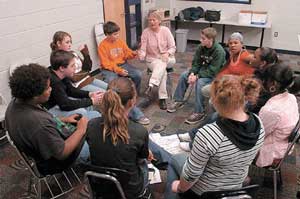
Debbie Little, restorative practices coordinator, South Lyon, Michigan, Community Schools, conducts a circle at Centennial Middle School. Hal Gould, South Lyon Herald

 Educators around the globe are using restorative practices to proactively prevent problems like bullying and violence. Research shows that restorative approaches can transform student behavior and build healthy school communities. Part I of this two-part article looks at what educators and trainers say about the benefits and strategies of implementing restorative methods. Part II will provide quantitative analyses illustrating the impact of restorative practices in schools.

Learn about the IIRP SaferSanerSchools™ program.

Read more

RJ in the Land of the Long White Cloud: New Zealand Embraces Restorative Justice for Adult Offenders

Published: March 15, 2007

Dramatizations of conferences from a film made by the New Zealand Ministry of Justice in 2001 to train facilitators for the Courts Pilot

While it would be an exaggeration to say that restorative justice (RJ) has completely overtaken conventional forms of justice in New Zealand, RJ has made as much headway on the island nation as it has anywhere in the world. RJ processes—mainly conferencing, based on practices adopted from the Maori people of New Zealand, in which offenders, victims and their supporters meet face to face to repair the harm caused by crimes—are being implemented in the country of 4.1 million throughout the criminal justice system.

Unlike a court trial, where lawyers argue the law and impartial justice is meted out by juries and judges, conferencing puts those most affected by crime at the heart of the process. Victims, who are often unable to face or speak to offenders in court, are given a chance to express how they feel and have a say in the outcome.

Read more

Justifying Restorative Justice: A Theoretical Justification for the Use of Restorative Justice Practices

Published: February 23, 2007

This article by Zvi D. Gabbay, analyzes the premises of the main theories of punishment that influence sentencing policies in Western countries and compares them to the basic values of restorative justice. Originally published by the Journal of Dispute Resolution, a publication of the Center for Dispute Resolution of the University of Missouri School of Law.
Read more

United Nations Releases "Handbook of Restorative Justice Programmes"

Published: January 12, 2007

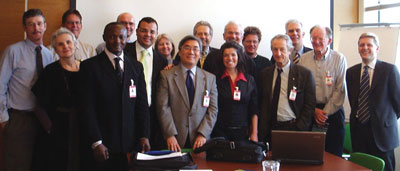
The Experts Group meets to discuss the United Nations Handbook of Restorative Justice Programmes, in Vienna, Austria, January 2006.

Restorative practices got a boost last month with the publication of the Handbook on Restorative Justice Programmes by the United Nations Office of Drugs and Crime’s Criminal Justice Reform Unit (UNODC CJRU). The Handbook, a free publication, serves as an introduction to the theory and practice of restorative justice. A hard copy is available from UNODC RJRU (This email address is being protected from spambots. You need JavaScript enabled to view it.) or online in PDF eBook format.

“We felt we needed to offer a tool,” said Ricarda Amberg, officer-in-charge of the CJRU. “[This is] resource material that gives a snapshot view of what restorative justice is all about.”

According to the UNODC CJRU’s webpage, “Criminal justice reform is at the heart of the mandate of the United Nations” (http://www.unodc.org/). The Handbook is the latest in a series of efforts by the UN and the CJRU to encourage nations to develop alternatives to imprisonment and make restorative practices a component of their criminal justice policy.

Read more

Restorative Conferencing for Serious Offenses: An Exploration

Published: December 5, 2006

This article is adapted from a keynote speech by IIRP president Ted Wachtel, at the International Conference on Serious Violence and Restorative Justice, Bar Ilan University, Ramat-Gan, Israel, March 2006.

Can restorative justice conferencing be valuable in cases of serious offenses — crimes like murder, sexual abuse and arson? A restorative justice conference is a structured meeting between offenders, victims and their supporters in which they deal with the consequences of a crime and decide how best to repair the harm. Can victims of serious crimes benefit from a process where they face the people who have caused the crime? Can this process also have a positive impact on individuals who have committed such crimes?

What we do know is that almost everyone who participates in a restorative justice conference — victims, offenders, their family members and friends — has a favorable reaction to the process. They are satisfied and they feel a sense of fairness. Relationships are improved and a sense of community is achieved. In fact, many victims experience dramatic positive outcomes that they do not seem to be able to achieve any other way.

In a composite analysis of research from Australia, Canada, the UK and the US, Dr. Paul McCold, at the International Institute for Restorative Practices, found that victims and offenders almost universally have positive responses to restorative justice. Also, recent research published in a dissertation by Dr. Caroline Angel showed that restorative justice reduces the incidence of post-traumatic stress symptoms in victims (see article here).

Read more

Papers from the 8th International Conference on Conferencing, Bethlehem 2006

Published: December 1, 2006

View papers from the 8th International Conference on Conferencing held October 18-20, 2006, in Bethlehem, Pennsylvania, USA.

Read more

Page 90 of 106

  • 85
  • 86
  • 87
  • 88
  • 89
  • 90
  • 91
  • 92
  • 93
  • 94
  • Restorative Practices: Explained
  • Presidential Paper Series
  • Restorative Works Magazine
  • Restorative Works! Podcast
  • Resources
  • News & Announcements

Restorative Works Cover
Restorative Works Year in Review 2025 (PDF)

All our donors are acknowledged annually in Restorative Works.

Contact IIRP

531 Main Street
Bethlehem, PA 18018

(610) 807-9221

IIRP on Facebook (opens in new window)IIRP on X (formerly Twitter opens in a new window)IIRP on BlueSky (opens in new window)IIRP on YouTube (opens in a new window)IIRP on Instagram (opens in a new window)IIRP on LinkedIn (opens in new window)

Get to Know Us

About the IIRP

Restorative Practices

News and Announcements

HEOA Consumer Information

Accreditation

Meet the IIRP

Employment

Digital Accessibility Statement

Explore Programs & Resources

Master of Science Degree

Graduate Certificates

Professional Development

Collaborative Application

Resources and Research

Events, Conferences, and Summits

The Commons

Get Started

Start Your Graduate Application

Register for Professional Development

Request Customized Experience

Become a Trainer

Browse the Bookstore

Whole-School Change

  • Restorative Practices
    • Restorative Practices: Explained
    • Presidential Paper Series
    • Restorative Works Magazine
    • Restorative Works! Podcast
    • Resources
    • News & Announcements
  • Graduate Education
    • Graduate Programs
    • Course Offerings
    • Registration & Admission
    • Transparent Tuition
    • Scholarships
    • Recruit Our Students
    • Philosophy & Academic Goals
  • Continuing Education
    • View All Offerings
    • Professional Development
    • Bring Our Events to Your Team
    • Restorative Practices Training of Trainers
    • Conferences & Symposia
    • Free Webinars
  • Collaborative Application
    • Consultative & Implementation Services
    • Whole-School Change
    • The Commons
  • About
    • The IIRP Graduate School
    • Message from the President
    • Who We Are
    • Support the IIRP
    • Employment at the IIRP (opens in new window)
    • Accreditation Information
    • Research Agenda
    • Lenape Nation Acknowledgment
    • Consumer Information (Higher Education Opportunity Act)
  • Contact Us

© 2015 - 2026 International Institute for Restorative Practices | Site Map